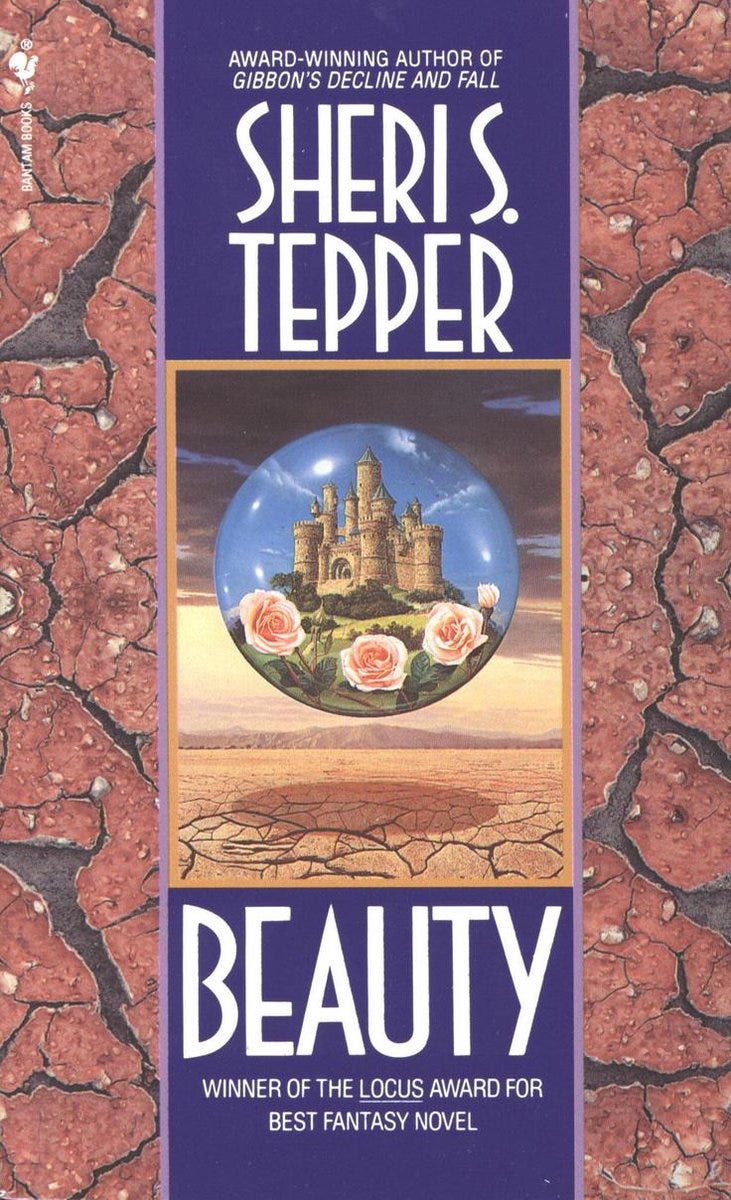
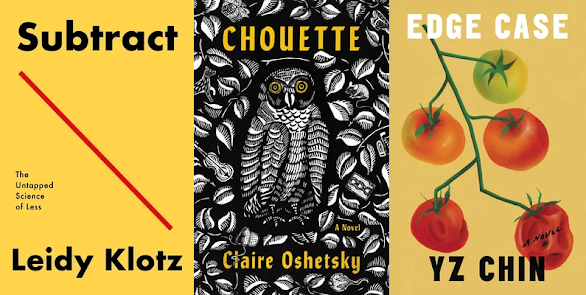
I don’t remember now where or how I heard of Sheri S. Tepper or her novel Beauty, but when I managed to run down a copy, I was expecting Sleeping Beauty Finds her Way to a Modern Dystopia. Which sounded like it might be a fun addition to the ever-evolving list of dystopian novels I offer my students each semester.
Spoiler alert: it’s not making the list. Her time in the dystopia is not that many pages, although those pages have a blackhole-like gravity that changes the shape of the rest of the novel.
The novel is wonderfully varied. It starts in the 1300s with precocious young Beauty. She sneaks out of the curse but then bumps into documentarians from the future who take her back to their home, a place that reminded me most of THX-1138. Eventually they escape to 1990s Los Angeles (it ends up, the explosion of homeless populations in the ‘80s and ‘90s was largely do to dystopian escapees. But then she goes back to her home time and then to an entirely imaginary world and to Faery and eventually even to hell and all kinds of strange and marvelous places. We see her age well past age one hundred (being half faery herself, she can live quite a long time). These places are marvelous to visit and their inhabitants too are wonderful to meet and observe.
By any reasonably measure, this book should be considered an absolute modern classic up there with Princess Bride or Earthsea or The Last Unicorn. So why isn’t it? It won the Locus Award. It’s not like people didn’t discover it. So why is there only one copy (in a plain mass-market paperback, no less) in our 65-interconnected-library-systems system? Why has it vanished away?
I think I know the answer. And it comes down to Tepper making subtext text.
She has political opinions and she needs you to know about them. Some of them (like the evils of mass extinctions and overpopulation and men who write horror novels) are hit hard—and over and over. Some just get a couple deeply unsubtle sentences (abortion, for example), but regardless, she doesn’t want you to misunderstand her. And she’s a-gonna cram’m all in.
Look: I also don’t like mass extinctions. And while the risk of overpopulation doesn’t really seem like the problem it did in the 1970s (overconsumption on the other hand…), I get being worried about it. The problem is Beauty harps on these issues So Much (like a lazy dystopian novel) that it starts jumping in front of the novels many, many excellent qualities, waving its arms and shouting, Do you get it? Do you get the point? Do you see the point I’m making and understand why this point is important? Do you do you do you? And it’s upsetting because this novel is so dang good in so many ways.
In one sense, this is just a matter of aging poorly. And this I take as a lesson. I have a novel that’s a third written which is going to demand me diving into contemporary politics and their eventual results. And another that a publisher actually wants to see that is always trying to get me preaching my opinions about the current state of law enforcement. In both cases, the issues are plot-centric and vital to the overall story. As they were in Beauty. But I need to be careful or they may render my novel entirely and solely an artifact of the 2020s. And I don’t want that.
In another sense, maybe Tepper made the right decision. Maybe it’s better to assure no one can miss the important issues you want them to see. Perhaps that’s the responsible thing to do when you’re given a platform. Maybe I’m just being an aesthete and a snob rather than a proper human being and contributing member of society. Could be.
I dunno. But I think that’s why Beauty is not today in 9 out of 10 American libraries.
But I want to come back to another of her soapboxes, her tirade against men who write horror novels. It seems pretty clearly aimed at writers of the era like Stephen King and Clive Barker (not that I am equating those two). This novel explicitly says that novels like theirs lead to people committing evil acts. It explicitly states that their making of these works gives power to the devil. It says that creating evil art (which is what she says they are doing) is morally equivalent to actually performing such evil actions in reality. Because art as creation is just as real as acts performed within God’s creation.
Needing to discuss this aspect of Beauty is why I finally wrote the Neil Gaiman essay I’d been postponing. For two reasons.
First, few people have written more elegantly or voluminously than Neil Gaiman about how believing in things make them real, even if they are born of pure imagination.
Second, because, as I discussed in that essay, many people see bad things in art being evidence of the artist being a bad person—and vice versa.
Never mind the irony of Beauty having one of the most upsetting rape scenes I have ever read (or its horrifying descriptions of a hell made up of male artists’ evil imaginings), I just find it kinda bonkers that a writer of Tepper’s skill and depth can be so dismissive of other people’s work. I’m not saying art intended to be evil cannot exist, but to spend so much of your own novel preaching down to the sinners whose work you don’t like is wild to me. (Not that writers don’t do this all the time, but man, does she come down hard on horror writers. She might not like that Wikipedia says the same of her.)
The point of all this is, I think, writing advice to myself.
Character and story, plot and setting, these are the true providence of the novel. As the horrible person Stephen King wisely wrote in On Writing, of course books should have themes and whatnot. And yes, in rewrite, the text should be sculpted so such things resonate to maximum effect. But never should they be the most visible and pointed-at aspect.
Beauty is an incredible accomplishment. And I think its forgotten entirely because it forgot the reason people read novels. All the points and arguments in the book could have been left below the epidermis of storytelling and still come through just fine. But she couldn’t do that. She couldn’t risk us missing them.
And so future generations will.
If you’ve read the novel, I’d love to hear your take on it.
If you stick with me to the end, we'll together take a trip to hell. En route, I am afraid we will see murders and imagined murders and ancient battles of the sexes. Are you strapped in?
This collection is a deliberate single story and it's a great example of what Gaiman is good at and what Sandman is good at. It has sex and violence, beauty and horror. It has fine lines and opportunity for the artists to play around. Fascinating characters both lovely and despicable, both knowable and inscrutable. It shows people and places that can otherwise be so easy to never see. Deliberately, accidentally, it hardly matters—we simply do not see. The pacing speeds up and down. Major characters take their place in both fore- and background. Minor characters as well. Meaning is suggested and then swayed away from.
He's found his rhythm.
almost a week
104)Hallowe'en Party by Agatha Christie, finished September 2023
The new librarian is attempting a book club with the teachers. I'm game. And the first book is this Hercule Poirot mystery, the movie of which I may have watched last weekend had I not begun the book instead.
I must say the trailer confounds me:
Wikipedia says the movie "transpose[s]" the action from the novel's bucolic village to Venice, but other than some water, a girl, and a friend of Poirot's who happens to be female, what to they have in common? The novel has no seance, no psychics, no locked-room aspect, no supernatural element of any sort, basically nothing that appears in the trailer whatsoever.
Some English townfolk in the '60s are preparing a Hallowe'en party for a couple dozen local kids. One of the kids is murdered at the party. Poirot is invited by his friend to investigate. He does. He wanders around the lovely countryside having conversations.
I still want to see the movie but I haven't much worry that reading the novel will spoil anything for me.
The structure of the novel was fascinating. It's a very slow burn. It really is just Poirot walking around talking to people. The last couple chapters add some suspense and propulsion but otherwise the entire runtime is cozy in the extreme.
Nothing like the trailer whatsoever.
Can't wait to see it.
I hope I enjoy it as much as the book.
But, if I do, I anticipate an entirely separate sort of enjoyment.
I know the names of Lianne Moriarty's novels from prestige television adaptations and for some reason (petty snobbery?) I find that a turnoff so I never would have read this book were it not for the great pleasure it gave my beloved when her book group read it. I mean---she was having fun, people. So even though it's almost 500 pages, I picked it up as soon as she was done.
And folks, this is a solid piece of entertainment. Well structured, littered with terrific characters, plain but nonagressive points roiling beneath the service---enough to trigger all your layered pleasure centers.
For instance, it has a lot to say about what we inherit from our parents (like it or not) and sometimes it was frustrating how clearly we could see things the characters could not---but, well, that's exactly how people are. It did not make me believe in the characters any less.
As for the structure, I was just complaining about a book that attempted something similar; this one has perfect execution. There's no diminishment of suspense. I mean---I was convinced at one point of [redacted] only to discover [redacted] when I picked the novel back up the next day. What a delightful reading experience!
The opposing emotions this novel forces upon you prevents a simplistic reading of humanity. People are complicated. Yet Moriarty loves humans. You can tell. Even the clearest villain of the novel is treated with grace. Yet part of the reason for this is which character consists of the emotional and ethical core of the story. She's not a saint or anything but her presence---even in her failings and errors---makes everyone else better.
One of our Sunday School teachers brought some of the ideas in this text collected from printed interviews and podcast appearances. I went ahead and hunted down a copy because I was intrigued by some of the details about women wearing veils and such (all cut out of this episode) and I've been reading it on Sundays since.
First, Sarah Ruden is an excellent writer. Her company is very welcome as we take this journey, trying to understand ol' problematic Paul as his contemporaries would have understood him.
In short, almost all the things that drive us crazy about Paul in 2023 AD are because we don't know what the world was like 55 AD. The woman-in-veils thing, for instance. At the time, you weren't allowed to wear a veil unless you were wealthy or married. And not wearing a veil meant you were sexually available to men who felt like so availing. But when a woman comes to church? It doesn't matter who you are in the outside. In church, you can all wear veils. We are all the same here.
She similarly brings us into other aspects of Roman culture, revealing how our default assumptions don't really apply to Paul's acolytes' realities. He was not talking about anything like our world when he came out against gay people or seemed upsettingly ambivalent about slavery. We don't even understand what he meant by words like "father" or "child" or "love" or "faith." Two thousand years of domestication has resulted in doctrines that make us think this is a wolf:
I really can't recommend this book highly enough to any layperson who has been frustrated by Paul and wants to understand how this grumpypuss managed to craft the Christianity we still celebrate today.
Ruden's expertise in, as she puts it, "the literature of food, clothes, sex, family squabbles, petty commerce, local politics, and staying out of the rain," allows her to bring in her own translations from a world so different from hers that you will never read more shocking, upsetting, horrifying stuff in a book I read almost entirely over a series of sabbaths.
His world was not our world.
Understanding that helps clarify just what Paul was getting at.
And how devastatingly radical it was.
Ultimately destroying the Greco-Roman world and building one where such concepts as freedom and equality, the Enlightenment, democracy—our entire modern ideal—could take seed and grow.
Paul showed us the ideals we are upset he doesn't meet, like self-righteous teenagers discovering morality and holding it up to the adults we know.
It's an old story.
Hey—we all still think as a child and see through glass darkly. So perhaps we need to read Paul because we are more like him than we think.
three weeks
108)Cymbeline by William Shakespeare, finished October 5
What a weird one this is. It's like it takes all the things I find strangest about Shakespeare's plot and characters, sticks them all together, then renders them even more absurd. Innogen is a reasonably likeable character but all the other leads are absurd caricatures. This poor woman having to live in a world filled with so many knuckleheads.
I saw a Cymbeline recently, a stripped-down version that leaned into the queer readings without actually making them clearer and played pretty much everything for laughs. (Who knew a headless corpse could be so funny!) A couple of the performances were excellent (Nathaniel Andalis in particular was a revelation) but the play mostly wanted to be easy to like. And it was. Perhaps Jupiter should always play the electric guitar.
I've also read long essays about Cymbeline by Stanley Wells and Harold Bloom who have very different takes on the play. I largely accept both their readings (which should upset them both) in part because the play is so strange it's easy to accept all sorts of possibilities.
Of the other strange plays (the problems, the romances, the whatevers), this is my least favorite. But I hope someday to see a production that makes me feel about it as Wells does. Prior to the Victorians, this was one of the more beloved plays. Maybe it can be again.
001)The Dark Room by Gerry Duggan & Scott Buoncristiano, finished January four 002)The Only Harmless Great Thing by Brooke Bolander, finished January 6 003)Rose by Jeff Smith and Charles Vess, finished January 10 004)Acting Class by Nick Drnaso, finished January 10 005)Red Scare by Liam Francis Walsh, finished January 11
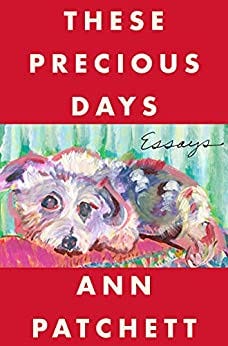
I’m not mad at Ann Patchett. She is, in my limitedexperience, excellent. And while she should accept some responsibility for what I’m about to complain on, John McPhee has persuaded me that my ire is rightly directed to the publisher and their role in checking things, making them correct.
I have been moaning lately about editorial staffs failing to back authors up (example [17], example [44]), but this one is the most shocking. This is a collection of essays—
—by a major American author published by HarperCollins. And the essay I wish to speak about "(“To the Doghouse”) was previously published in the Washington Post. Now, that version was much trimmer, but I’m pretty sure that what’s published in These Precious Days is the original version, before the newsfolk cut it down to meet inches.
Anyway, that version, if you look at it now, includes this notice:
[CORRECTION: An earlier version of this essay incorrectly stated that, in one “Peanuts” strip, Linus asked if Snoopy could come out to play, and got a rejection letter. It was Rerun, Linus’s brother, who made the request.]
This is a correct correction.
The corrected sentence did not make it into the book version.
In fact, not only is that error not corrected, but elsewhere in the essay, Rerun is referred to as “Sidecar”
which, best I can tell, is not a name anyone else has ever given Rerun in the entire history of time. This should have been an easy catch.
Anyway, I didn’t track down comics for all the times Linus appeared in the essay, but I suspect up to three other times it is actually, once again, Rerun. (We need an online Peanuts concordance. I know you have one.)
Now maybe Ms Patchett hasn’t read Peanuts since she was a kid but that’s where a good editorial staff comes in. And the fact that one error WAS ALREADY FLAGGED BY THE WASHINGTON POST makes this panoply of failure all the more embarrassing.
So I recently picked up a free copy of Banana from LibraryThing's Early Reviewer program. (I don't use LibraryThing so much these days, but it is still a cool site that offers good things. I paid for a lifetime membership. This is me. You know. Should you wish to say hi.)
Anyway, Banana is a very cutting allegory that isn't really an allegory at all because its symbols will cut wherever you aim them. It's been marketed as a book about parental distraction, but it can talk about distraction of anyone from anything by anything. It's a solid picture book and a fun read and a great book to spark conversation with a six-year-old, but it . . . I don't even own a phone, but it might have cut a little close.
Still. I liked it enough that I immediately put every other Zoey Abbott book at the library on hold. They arrived and the six-year-old and I read them, and man alive is this woman a significant talent!
All three of these books are excellent, but I will take them in order from successful to brilliant. (Incidentally, I'd put Banana somewhere in the middle.)
Incidentally, these books—all the ones available which she has both written and illustrated—were all released in the last twenty-six months. So she's on a tear and I suspect her publisher shares my high opinion of her. Publishers, actually. Only the last two are from the same imprint.)
This wonderful little girl loves the oldfashioned world of stamps, of writing and mailing letters.
But she does not love Yolanda, the terrifying woman who works one of the counters at her local post office. (I could tell you which one, but the endpapers are filled with her letters and envelopes so why not let you enjoy learning for yourself?)
Eventually, things warm between them (thank you literature. and food. and literature about food.)
It's a good book. It has a lot of heart and honesty. But it would not make me put someone's other books on hold. Even though I am becoming a great sucker for picture books and the last line made me choke up.)
The first half of this book I'm thinking about using as a writing prompt for my sophomores next year. Horse is trying to help Pig distract herself from her fears and anxieties.
Eventually, they invite her fears to tea and Zoey makes the choice to define them more specifically, which is probably the right choice for her target audience, but it's where I would end the book for my own pedagogic purposes.
Anyway, the book is lovely and useful. Horse is both a good friend and at times distinctly unhelpful. Pig is both brave and afraid—and models dealing with fears that are of debatable substance. It's good stuff.
Look: this is a book in the tradition of Grand Orphan Adventures and it happily checks boxes we know from fairy tales and Roald Dahl. Clementine is a delightful heroine and I love her lots.
But then the lion moves in. And the story does not go at all in the direction I expected.
Zoey Abbott has a knack for stories that feel allegorical but can actually be interpreted in plenty of ways, so when I tell you this is probably the best representation of marriage I've seen in a picture book, I do not at all expect you to agree with me. But that was my experience.
I loved it.
My guess is none of these first four entries is her Wild Things or Goodnight, Moon or Guess How Much I Love You. No one, no matter how skilled, is guaranteed a book like that. But my guess is she'll get one.
And it might not be better than what she's already given us.
Note: the images above all link to Amazon. These books are also available on Bookshop. Though so far, I am earned zero money from Bookshop clicks. Which I'm afraid might tell me something about my audience. Ahem. Here are the Bookshop links by publication order: I Do Not Like Yolanda, Pig and Horse and the Something Scary, Clementine and the Lion, Banana.)
I suppose I should be embarrassed by this, but I've never read Anne of Green Gables or, indeed, to to best of my knowledge, anything by Lucy Maud Montgomery, ol' L.M. I say that because thanks to LibraryThing, we own a couple knockoffs, a board book and a no-longer-early-but-not-yet-middle-grade reader. I'll talk about them in a second.
First, I should just cop that my knowledge of Anne is pretty much entirely based on the 1985 Canadian miniseries and its various sequels and spinoffs. Largely, I saw them many times because my what my sister loved became what we watched as a family but, unlike, say, Punky Brewster, I liked it too, and it has sunk deep into my person.
Last January, one of my AP Lit students for her book-of-your-choice presentation talked about Anne's first book and thus I learned about the deep love for Anne in Japan and realized I am way, way overdue to read her myself.
A couple years ago, I told you about a brilliant for-kids comics adaptation that made me weepy, and reading Anne's Tragical Tea Party aloud today was nearly impossible. My voice wouldn't stay uncracked. I tried to let it own when appropriate, but there were tears down my face by the end.
Anne's Feelings I first read some time ago (and later got Anne's Colors from the library, as well) and utterly loved it (and it). I love the based-on-classic-lit boardbook phenomenon, and these are solid entries.
But I definitely have a problem. I just teared up via Look Inside with this one I've never heard of before:
Of the 131 books I read last year (this includes books read more than once):
42 were books I owned prior to January 1, 2020
60 were library books
6 were books I picked up for free including 3 from an author or publisher and 1 as a gift
3 were borrowed from my mom
4 were read online
and 12 I purchased in 2021
Which seems to add up to 127, so I screwed up somewhere. But these numbers are good enough to prove I failed at my goal.
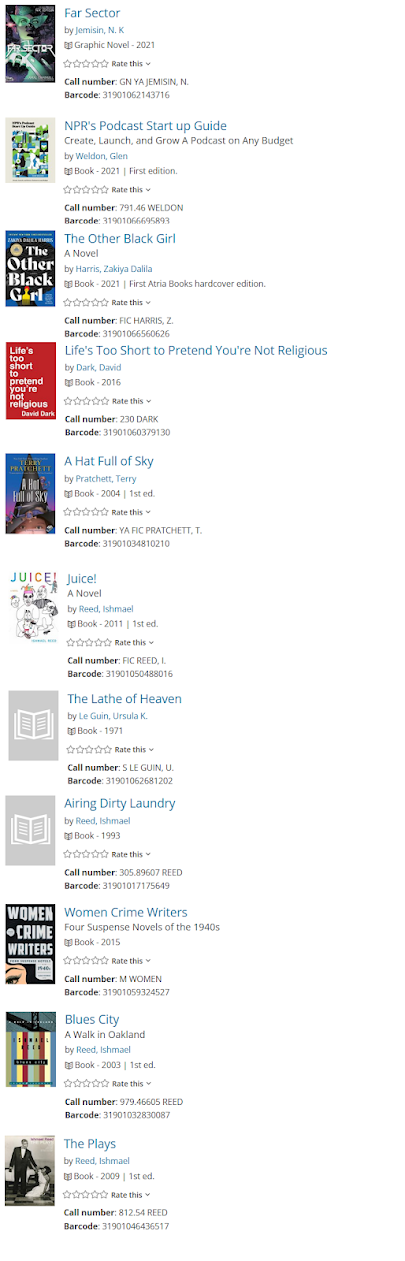
Perhaps even more telling is this information accessible from the library's website right now, the books I have checked out:
I'm not equally serious about reading all of these (not to mention the three books I have out on interlibrary loan or the fifteen books currently on hold). For instance, I really want to read Ishmael Reed—but none of the books at my local library were top of my list. And I'm about a third through the religious book (heard about here); if I owned it, I would eventually finish it, but I don't and I got the gist so it'll probably go back before I'm done.
The thing is, I just really want to read the books we own. So I'm going to try and at least read MORE of my own books than I do library books in 2022. Should be manageable, right? I mean, I just used giftcards to get these three on Barnes & Noble's 50%-off-hardbacks sale and I'm excited to get past the second page:
I only knew Kim Addonizio from a very short story and its accompanying photo—but that was enough for me to remember her name and to allow the back of the book to hook me.
I love this collection. The poems are sharp and vernacular. They're recursive in interesting ways (references to Keats, sonnet-like sonnets) and they speak with complexity without pushing away. I enjoyed it immensely. I should have carried a pencil and then I could now be quoting lines.
I did not however. Alas.
Incidentally, I picked this up because it was in my 40ish-strong collection of recent collections that I've been acquiring from my neighbor's Little Free Library (everybody hopes she'll write them a review). For the first time, I dropped this stack of books on my AP kids, just to see what they would think. I'd assumed they would find the poems oppressive and impossible, but they settled right in and read. I had to interrupt them after an hour so we could talk about what they'd discovered. I was hella impressed, to be honest.
It walks that line in a slightly more interesting way, however. All the stories are connected thematically (young people in love, with music) as they stretch over the Twentieth Century. One story in particular keeps getting revisited (they meet at a Beatles concert, they end up living together, they end up separated, they keep bumping into each other as Beatles die), largely in the form of letters written (or, finally, not written) to each other, their lives in parallel. Between these looks in, we visit other characters who struggle with mussy relationships.
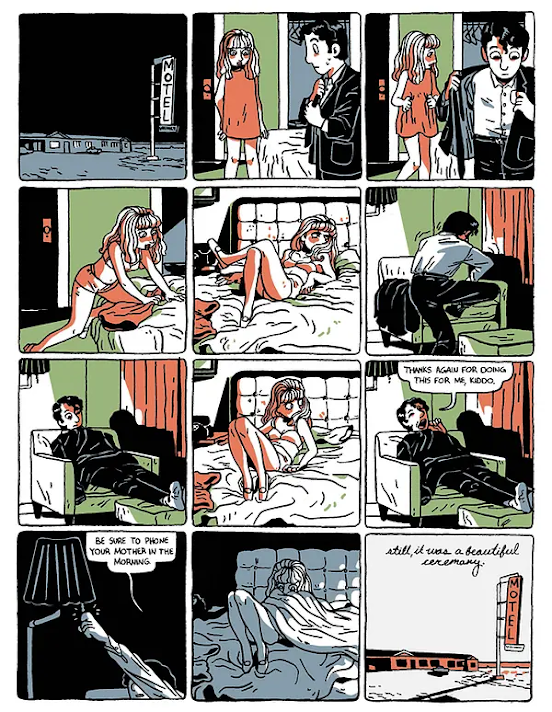
Anyway, I liked it fine. It did some interesting things with form and color, but I rather doubt I'll remember it. Here the moment after a sudden wedding that should not have happened:
So, first, I loved this book. It's the story of a Singaporean comics artist who has spent his entire life struggling to do great work without money or acclaim. He tries on style after style and, although he executes them all with excellence, he ends up, to my Western eyes, as merely derivative of Tezuka of Pong or MAD or Carl Barks. But although he's borrowing other artists' vernacular, his uniquely Singaporean use of his talents is mindboggling. You want him to find success, even if the recognition comes too little too late ala Jack Kirby. His 1988 visit to San Diego Comic-Con International is particularly heartbreaking.
And through it all, Sonny Liew is our guide. It helps to have a native.
Anyway, it's a beautifully designed volume, generously including swathes of Chan's art through the various stages of his career.
But, it was a brilliant book—until I finished speedreading the endnotes and the acknowledgements and realizing halfway through this was the same author bio on the back of the book—and then I read the copyright page and it changed from merely a brilliant book to a work of genius. But please, don't start with the copyright page. Don't start by reading anything out there about the book. Just start at the beginning and make your way through.
since saturday
087)The Oven by Sophie Goldstein, finished on August 31
It's the distant future. Our heroes, man and wife, arrive at some galactic outpost to live in a trailer park where they will be free to live in the old way. To farm and have children. It's a wild and alien existence for them, even if to us it seems only fifty years past.
Of course, the plot thickens, etc.
I love the orange monochrome of the art. I like the simple character designs—one character always has closed eyes, like a Syd Hoff character. The book is very short, but it finds depth in its ambivalences.
required one bathroom break
088)Witchlight by Jessi Zabarsky, finished on September 3
Here's a fantasy novel that knows what themes are important to it but pushes them so hard that it confuses whatever the point was supposed to me. Which is too bad. Witchlight has plenty of cool and interesting elements (my favorite is the candle) but the hiccups in worldbuilding result in a largely confusing exercise.
The best example of what I'm talking about is its excision of men. Except at the very beginning and a couple moments near the end, there are no male characters. All characters are either female or female-adjacent genderqueer. Which could be fine, but then, with the introduction of a male character at the end who inflicts violence and it's supposed to mean something, the meaning is muddled. I could provide a couple interpretations but they would be contradictory.
I'm sure reading Witchlight will give the YA segment it's targeting some good feelings, but intellectually it's a bit vapid.
three or five days
089)Loverboys by Gilbert Hernandez, finished on September 3
This takes place in the same town as Marble Season although it's decidedly less kid-friendly. It deals with a divorced-woman stereotype. In this case, a teacher starts sleeping with men who were here students in their recent high-school past. It's a complicated thing. The most serious of them is the son of the widow who ran off with her husband, for instance.
Some of the moments near the end felt very familiar but I don't have a record of reading this book. Maybe it was excerpted in a Best American Comics.
I do love how Gilbert's smalltown stories feel so real while maintaining the ability to incorporate fantastical elements—sometimes big, sometimes small.
Someone picked this book from a free pile last week and today it is already loved into a pretty rough shape. But the kids love it, young and old, delighted to read some Calvin and Hobbes strips they had not before read (let alone dozens of times).
I finally got my hands on it. As I assumed from the collection's title, this takes us into the final stretch of Calvin and Hobbes, ending with the final strip. But there are hints throughout that Watterson is done. Take this from the final week:
But this isn't to suggest that he was coasting. Not at all. The art is still spectacular, the writing still clever and wise.
It's a generous close to his decade-long run and I hope we're all still grateful.
Some where (can't find it now) Matt wrote about feeling a bit sheepish he was shortlisted for the AML Award for comics with the first volume of this series. And really, just sheepish with how much buzz and talk as comicsthat book received. So resolved to make volume two include more comics.
Which made me glad as, frankly, I felt rather the same. And I am very pleased to say that this book is everything—as comics—that the first book was merely almost.
This book engages more deeply with the capabilities of graphic storytelling. Plus, it's just more interesting! The explanation of Triple Combination's past is nothing I've ever seen before and I'm excited to see where Matt goes next.
The noncomics bits (eg, the advertisements for the Future Day Saints vhs tapes) are as delightful as ever and take up the appropriate amount of space, imho. The bad guys got more interesting and the rules of this world were muddied—not in a Matt-doesn't-know-what-the-heck-he's-doing sort of way, but in a there's-a-lot-here-yet-to-be-explored sort of way.
Volume two came out much much faster than I anticipated. Here's to hoping volume three has just as speedy an arrival!
one day
072)Dutch House by Ann Patchett, finished on August 5
Lady Steed and I read and loved Bel Canto simultaneously. Since then, she has read several more of Patchett's books. I have not until now, with The Dutch House.
I read an article over Lady Steed's shoulder—an interview with Patchett about the novel and about its painting and about the audiobook narrated by her friend Tom Hanks. Lady Steed had already read the book and was almost finished with the audiobook, but we had a long drive ahead of us and she was happy to start over. So I listened to the first fifty pages via Tom Hanks's (excellent) narration (and, later, another twenty or thirty pages in the middle) while reading the rest myself.
Anyway, so it's about this house. Not really, obviously, but also, it is. It's about unique miseries and unique privileges and, specifically, the people these things happen to. The characters never stay one-dimensional, even when other characters try to make them so. The plot unfolds almost invisibly even though this is a novel that provides surprise after surprise.
In the end, it is another work of beauty and honesty. And it makes you wonder why we all haven't read more Ann Patchett.
Anyway, as I type, I realize I'm loathe to give anything away even though I think nothing I might give away could negatively impact your experience.
Your potential experience is simply to wonderful for me to put my grubby little hands upon.
I wish I liked this book more than I did. Visually, it seemed to be taking some (less exagerrated cues) from Jeff Lemire. It's trying to tie into a curious mix of Norse and Christian mythologies. It mixes realism and fantasy. It's fun monochrome. It's a lot of stuff I like!
But . . . I never quite understood what it was all about. And I'm not convinced the creators do either.
I could (and would if this were a paid review) reread it a couple times and see if it comes together. But I'm not going to. I have three more library comics to read!
over midnight
Weirdly, however, these next two comics from the library, are NOT among the three I mentioned. It's fun to have long lunches across the street from a library!
074) House of Women by Sophie Goldstein, finished on August 10
The black-and-while style ranges from modern European comics to old
medieval European art to art nouveau to, most deliberately, Japanese woodcuts.
It's
a story in the far future. A group of colonialist nuns are sent by the
Empire to see if the native population of this island can be civilized.
What follows is a wealth of yonic images and an exploration of sex,
violence, and cultural collision. It's a fascinating book.
Plus, props for one of the finest author bios I've seen.
I had read one of the stories from this anthology before—online, I
believe—but can't remember where. I remember how great it was, however.
And every one of the little horror stories in the collection is at least
good and some are much more than that. The library has it in the YA
schedule and I guess so. I'm checking it out to share with my 12yrold.
But oooooooo, be careful.
(This image is from the story I had previously read, but I found it somewhere else. Click it to get your second witness!)
Not sure how I heard of this (someone on Twitter, maybe?) but I threw it on hold and read it to the 4yrold and she took away the basic concepts, no problem.
Next up: I'm assigning each of her three brothers to read it to her. It should be good for them too.
I've owned this book probably over a decade but I finally read it in preparation for an essay I'll be writing for SFRA (I think: official notifications come Monday [which is before I'm writing this but after I'll post it] but I've been led to believe I'm in). UPDATE: Notwithstanding the editor's hints, the ultimate decision was a no. I still look forward to the issue, but dang. I'd done a lot of reading and rereading and thinking and notetaking in preparation. Anyone want an essay?
It shares some interesting traits with the main novel I'll be considering (The Invisible Saint, to be reread next) but it's the contrasts that are most striking. So striking I'm thinking about adjusting the thrust of my essay to be more about these two books specifically.
The main character is Nick Holloway which I feel certain is a reference to Nick Carroway---although this Nick is even more shallow and flighty. This Nick does get to be the main character of his own narration yet he still remains almost as unseen. (There are some interesting comparisons to be made about Jordan and Alice and their differing relationships to honesty, but that's not the essay I have in front of me.)
Saint has skill. The chapter-one sex scene ranks among the hottest I've read and he can drag things out without boring us. He's clearly not a proper science-fiction writer, however, and the book has mistakes that should have been disappeared during editing. (Nick's description of his evolving relationship with revolving doors, for instance). What apparently impressed some reviewers was its attention to detail regarding the difficulties of being invisible (and Saint offers some opportunities to his invisible that H.G. Wells did not), his willingness to just forget other details for convenience will throw off regular scifi readers. What happened to all that invisible dirt, Saint?
Anyway, I marked a lot of stuff. Hope it comes in handy!
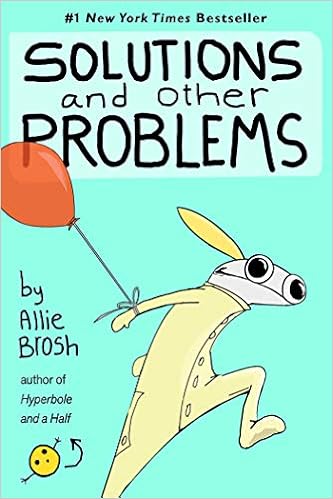
I've been reading Allie Brosh since before she had a book deal, and the stuff that appears in her first book was largely written first for the blog. And it shows. The physical version of her stories her damaged by the page-based format. With very few exceptions, that is not true of Solutions. The stories seem imagined with the pages in mind. And while there are occasional moments where panels should really be swapped (and maybe are in the ebook? if it scrolls?), Brosh has basically figured out pages and uses them now to effect.
Her art is excellent at conveying emotion and being humorous. She's refined her comic voice to a sharp edge. Which is necessary if she's going to tackle the extremely painful stories she tackles---the suicide of her sister, her own depression---things like that.
So much pathos fuels the comedy. I hope these books are healing. As the librarian and I said to each other when I picked this book up, we're glad she's alive.
I got the proposal rejection just after I finished the first chapter of this book which I love and which I have not read since at least 2007, when I started listing all my books read. I considered just not continuing, but I didn't want to risk having it tainted by bitter feelings. I enjoyed chapter one; I would read on.
I'm glad I did. The book has its flaws but I genuinely enjoy it. It would have been fun to really pick it apart, and, I have to say, the potential comparisons with Memoirs could have been legion. And part of what makes Saint better is how much shorter is. It doesn't get lost in minutiae and it's lead character's redemptive relationship isn't borderline abusive.
It's a simple pleasure. And simple pleasures have value.
a couple weeks
027)Black Orchid by Neil Gaiman and Dave McKean, finished March 25
I recently read about this book which somehow had never quite caught my attention before. It's the first big DC collaboration between Gaiman and McKean and its success led directly to Sandman. Seems like an important thing to read.
And it is indeed super-protoSandman. The Orchid herself has 80s rockstar makeup. The story delves into DC lore while casting it anew. It's morally complex and its violence is of the worst sort.
It is quite good. It does suggest the paths comics would take more than be those things itself, but it's more than an academic read. I enjoyed reading it. But it does make me look forward to the fuller freedom they are about to enjoy.
002)You're a Pal, Snoopy by Charles M. Schulz, finished January 4 004)Served edited by Theric Jepson, finished January 9 005)Served edited by Theric Jepson, finished January 17 006)Shem in Zarahemla by Stephen Carter and Jett Atwood, finished January 19
.png)