.png)
.
Just realized this is a perfect Valentine's Day collection: Youth, Having Babies, Disenchantment.
Enjoy!
006) Midville High: Comic Caper Collection by Matt Blair, finished February 5
Apparently Mr Blair started making these comics about high school when he was in high school and continues to make them now as a teacher himself. (The characters stay in the 1990s.)

This near-300pp collection has plenty of hijinks with bits of satire and parody. He's publishing them himself so some things like line-darkness aren't what you'd expect if, say, Fantagraphics had done the release, but the reading is fun and what more do you want? At times, it's excellent. There are moments where I was surprised he didn't get picked up by a syndicate or something. And he has the skill to produce a more high-schooly version of, like, Big Nate or something. I imagine he prefers control and is satisfied with the indie life but he has the chops to go big were that the goal.
But I don't know that a contract with Random House or something would be an improvement. Sure, the blacks would be blacker and a good editor could push him to higher states of excellence but there's a lot of pleasure in this handmade labor of love, and the purity might be lost in a shinier version.
saturday and thursday
007) Guarding the Moon: A Mother's First Year by Francesca Lia Block, finished February 10
It's funny it took me so long to read such a slight and readable book. I felt like I was devouring it at great speed—but then something would interrupt and it would end up under a pile and weeks would pass....
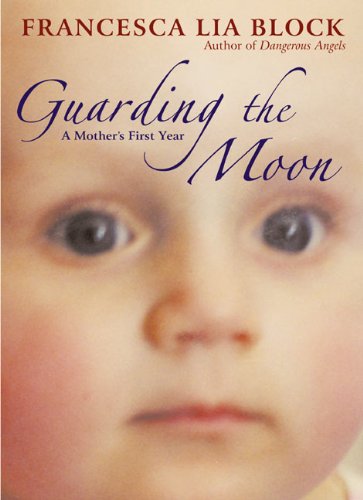
But I loved the book. Block's beautifully fluffy way to warping time and relationship on the page to match the feelingof loving another person was never better suited than to the true story of loving her first baby. Everything is fluid and nothing is stable and we are tired and mad and deeply in love and yes this is exactly what it is like to have a child,
It's terrific.
eight months
008) The Sellout by Paul Beatty, finished February 13
This is gonna be a multiparter, not all of which are about the contents of the book. Buckle up.
Memory is a fallible thing: I have a very clear memory of my first AP Lit training in room in downtown San Francisco, the summer of 2008. On the last day, there were a bunch of books on the back table. Of course I took some. Among them were at least a dozen copies of The Sellout, its flourescent-pink accents attracting the eye. They were there because CollegeBoard wanted to pressure us to teach more books like this—humorous, as I understood it.
Years pass. I have most of my copies in a drawer at school, waiting for me to read the one I have at home. The one I have at home is on a shelf beside the front door. The visible pink on spine fades out to a barely-there orange you can only see if you put your eyes right next to the paper.
I am embarrassed it is taking me so long. This was a NYTBR 10 Best! This got an award from th National Book Critics Circle Award! NPR called it a masterpiece! It won the Man Booker! It's slathered in exorbitant praise, mostly about how funny it is!
Anyway, I finally pick it up because this is the year I'm only reading books I actually own and it's actually working and one of the first things I notice is the copyright date: 2015.
Huh.
So....
I think my memory is correct. Except I think it's two memories combined.
I also suspect that contrary to what were told, it was less CollegeBoard suggesting we teach The Sellout and more Picador a subsidiary of Macmillan itself a subsidiary of the Georg von Holtzbrinck Publishing Group. Regardless, I would never.
Culturally responsive pedagogy—possible? I've been teaching long enough that I can note when things suddenly change. My two best examples are as follows:
I frequently teach Frankenstein to AP Lit and, when I do, we often watch a movie after the test. Most commonly voted for is the Boris Karloff–starring masterpiece, but occasionally something else gets chosen (especially when I'm teaching multiple classes and don't want to watch the same movie more than once in a day), for instance Young Frankenstein. Which is a great movie although there's a played-for-laffs rape scene that I've always hated. But other people find it funny so hey, maybe I'm a prude for not playing rapes for laffs myself.
Anyway, kids did laugh at that scene, same as their elders. And then, one year, like flipping a switch, they did not. They were deathly quiet and uncomfortable. And so it's been ever since. Which is simpler because it's easier to talk about it when we start on the same page.
The other big example, also from AP Lit, is August Wilson's brilliant Fences. Love that play.
When I started teaching it, I heard scuttlebutt from the online student-services center, that my Black students were grateful that we were reading it and for the way I was handling the plays language.
Then, one year, the scuttlebutt changed. I was getting forwarded complaints. That reading Fences was leaving my black students deeply uncomfortable and angry, that they felt by bringing its language and characters into the classroom was feeding racism among their peers and telling lies about what it means to be Black.
For a few years, I tried changing how we discussed the play, but the complaints intensified. Finally, I dropped it. I now have not taught it for several years. I miss it.
In fact, as time goes on, to keep students happy, I try to avoid teaching anything "culturally responsive." I teach almost entirely dead white Americans and Brits. This quarter, for instance, our primary texts are Steinbeck, Vonnegut, and Shakespeare. And, if everyone is not happy, at least they are not complaining.
I'm not exactly sure what's gone wrong, but I suspect part of it is depth. Fences might be more acceptible if I were also teaching The Emperor of Ocean Park and The Hundred Thousand Kingdoms to balance out the historical-fiction-where-racism genre. The problem of course is I should really also be teaching at least three novels exploring Tibetan-American culture and at least three novels exploring Mexican-American Culture and at least three novels exploring Japanese-American culture and at least three novels exploring Pakistani-American culture and at least three novels exploring Chinese-American culture and etc etc etc and you see quickly that the semester is not long enough. I hate this.
(I do have a few ways to mitigate the lilywhiteness of our major texts but the fact remains that the average actual single-author book we read and discuss as a class is more Jane Austen than August Wilson.)
Relevancy to the book: Oo boy.
So this is a book decidedly about racism. Racism here in 21st-century American. And it's not just "about" racism. It enacts racism in just about every imaginable way. It insists on placing racism literally front and literally center. Our main character, a Black Angeleno, finds himself owning a slave and instituting segregation.
See, his town has been taken off the map and segregation is part of the trick to bring it back. And not only does it, but the kids believing their school has been segregated leads them to instantly begin to excel. They're on their way to being the third-highest-achieving school in the state.
And of course I hate that but as I look back at what I've already written and am I inadvertently arguing the exact same argument?
The first half of the book I was mostly annoyed. I'm not pretending that post-racial America was achieved or anything, but it's so reactionary and angry I had a hard time finding my way in. And I wasn't sure I was welcomed in, regardless. I did laugh at a couple of the jokes, but most of them—I recognized that they were humor-shaped but I wasn't at all certain they would actually be funny to any slice of America.
The book starts at the end with the opening moments of our protagonist before the Supreme Court with normally taciturn Clarence Thomas losing his mind, cursing out our protag, calling him awful things, and finally collapsing into his seat with.... Well, this isn't the sort of blog that quotes what Clarence Thomas says.
And he's not the only real person to make a show here. Bill Cosby, Colin Powell, and Condoleeza Rice get raked over the coals but they also learn to Crip Walk. Barack Obama is weirdly a source of hope and pleasure but also no better than those other three. But time is weird here because we're both in his presidency and years before simultaneously. But Beatty isn't superconcerned with accuracy.
Or...sometimes he is. Some of what he says about geography or farming or surfing is so exquisitely detailed it's impossible to believe it's not true. But then our protag will plant an apple tree which'll die two days later but have apples on it. To which I express doubt.
I would argue back at myself that this isn't the kind of book to which accuracy matters except then why spend so much time getting us to believe it is accurate? And learning from this book that Stalin executed soldiers photographed with Americans when the two armies met on the Elbe for "fraternizing with the enemy" while I'm teaching Slaughterhouse-Five makes me want to share that tidbit but...given some (granted, casual) googling, I'm not so sure that's true.
This is a book which makes big claims on telling the truth and pumps itself full of realistic details. But this is also a book which proudly declares it couldn't care less about what's true as the fact is the facts matter so much less than the truth of things. As in "How to Tell a True War Story."
Which makes sense. One thing The Sellout makes clear is racism is war. Even if most people won't admit their in the fight.
So you hated it. No. No, I did not. It wasn't really to my taste and I wasn't sure the book wanted me reading it and for much of it I wasn't really enjoying myself and when the satire left the locals and went national I found it more silly than provocative, but—as it wrapped up, I found myself deeply moved.
The final pages with the restoration of his hometown and his memory of a standup comic took all the ugly and the chaos and the nonsense and wrapped it up with a humanist bow. The protagonist, whom I'd always found interesting, compelling, and genuinely human, ceased satirizing himself and his certainty, and opened up to show that, even he who weilds racism confidently as a both scalpel and chainsaw, doesn't know what's going on or what it all means.
I do sometimes wonder if we could all embrace our ignorances publicly and humbly we mightn't be a bit better off.
I don't know if that's true.
But as long as we all know what's going on, we never will.
about three weeks

Previous books of 2025
(and years more distant)
The first five books of 2026
001) Red Harvest by Dachielle Hammett, finished January 3
002) Never Let Me Go by Kazuo Ishiguro, finished January 14
003) Snoopy's Guide to the Writing Life edited by Barnaby Conrad and Monte Schulz, finished January 16
004) You Are Too Much, Charlie Brown by Charles M. Schulz, finished January 19
005) Ice by Anna Kavan, finished January 24
PRIOR YEARS OF BOOKS
2007 = 2008 = 2009 = 2010 = 2011 = 2012 = 2013 = 2014 = 2015
2016 = 2017 = 2018 = 2019 = 2020 = 2021 = 2022 = 2023 = 2024 = 2025

No comments:
Post a Comment