2017-12-27

Nearing the end of 2017, bookswise


.

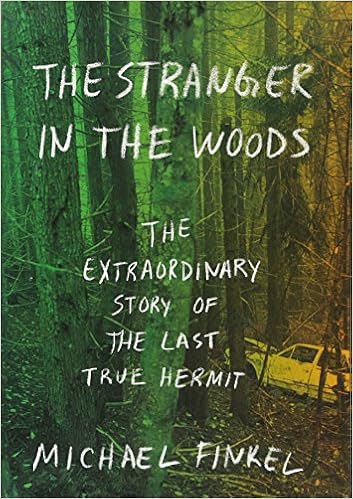
137) The Stranger in the Woods: The Extraordinary Story of the Last True Hermit by Michael Finkel, finished December 27

Here's the skinny: a man disappeared into the Maine woods and except for one Hi early on, never spoke to another human in almost thirty years, getting by on stolen food and batteries. Then he was caught and brought in. This journalist gets him to speak with him but, as you might imagine, the hermit is not the most sociable of fellows.
And he's long since given up worrying about what other people think about him. I do, however, wonder what he thinks of this book....

The book was provocative to me. Giving up society has always attracted me. Giving up my wife, however, impossible. I'm not sure she would sign up for a just-us deal.
And if we did disappear? What about later? I don't think I would be mad upon our return. And I think she might turn mad before the return. Anyway. No way to know for sure.

As a book, it's pretty light stuff. But the questions it passes by are dangerously fascinating.
a couple weeks


===========================================================


137) There Was a Young Lady Named Alice and Other Limericks edited by John Armstrong with drawings by Kovarsky, finished December 21

It's pretty much exactly what you're thinking. A bit repetitious, as sexist as it is sexy, best in small doses spread over a long, long time. Midcentury gags for men with martini glasses down at the club. Amusing, sure. Not much nutritive value.
piecemeal over maybe even three years


===========================================================


136) Agnes Quill: an anothology of mystery by Dave Roman et al., finished December 21

Dave Roman had an idea for a young woman who sees the dead and solves their mysteries and he worked with different artists to bring that vision to life, from the gritty to a pre-Smile Raina Telgemeier. It does feel about ten years ago in terms of how Agnes is being produced right on the cusp of the comics explosion (this book is roughly co-moment with Flight). It's not hard to see how, just a few years later, this would have been done on Kickstarted rather than with Slave Labor Graphics.
Much of the structure of and thinking behind the book feel now in a slightly less standardized form. It's a fine book but probably most vital as a comics-history water mark.
perhaps a couple months


===========================================================


135) The Complete Peanuts: 1999-2000 by Charles M. Schulz, finished December 20

I took a long time to start reading this volume because it kills me that it's all over now. I mean---sure, I'll get to start from the beginning again,
but it's over. Fifty years of Peanuts has come to an end.

There were signs. And I just don't mean obvious ones like the daily strip ending before the Sunday strip. I mean things like photocopied elements:


He never used to do this.

And lots of looks at mortality as well:


And although this isn't a particularly great example, over the last few years, the role of Franklin's grandpa has been a source of conversation about aging as well:


Then, suddenly it ends, and you realize, oh! gosh! we haven't seen Schroeder since September of '99! and you go backwards noting each last appearance when it shows up---the opposite of the early books when the appearance of Lucy! or Linus! or Sally! was a cause for Marvel.

I also want to strongly disagree with those who say Schulz was losing his touch in the final years. All you have to do is look at what he was doing with Rerun to know he had miles left in the tank and only death could end his phenomenal run.

* * * * *

Other notes.

Even though I already own them, adding Li'l Folks was a pretty good way to fill out this volume. Though I still would have liked a complete concordance.

Which reminds me: the index sucks in this volume. They started strong and got suckier quickly. You botched the indices, Fantagraphics. Why? why? why?

Now onto the final final volume of extras. I should feel rushed as Christmas is less that a week away, but what does it matter? No new volumes arriving from Santa this year.....
a monthish


Previously in 2017

note: due to a lucky digital error,
I was able to finish the aftermatter of #134;
the date has been appropriately updated

2017-12-18

Remember when we read?

.

134) DC: The New Frontier by Darwyn Cooke, finished December 17*

This book deserves all the praise it's garnered over the years. It's simply amazing. Moving. Characters so richly drawn. Ones I know well, ones I know poorly, ones I barely knew at all. Some close to the original. Some entirely reinvented.

This has the breadth and complexity of a fine epic novel. But by relying on myth and image, it manages to build that in fewer pages. I'm not sure what to compare to. Watchmen maybe or Kingdom Come. But it's neither of those. Like any great work, it is its own thing, and not just the sum of its influences and intertextuality.

Cooke's art style is, as always, wonderful to look at. I've always been skeptical it will work with serious subject matter, but it always does.

If you care at all about DC's stable of heroes, this might be their finest hour.
* maybe a couple weeks but I didn't finish the extra material before I lost my Kindle and library took the ebook back so this is really just the date I decided oh well


===========================================================


133) Stewart the Rat by Steve Gerber & Gene Colan & Tom Palmer, finished November 21

Gerber's best known for Howard the Duck. I have never read Howard the Duck and so I know he's an alien and drinks and that's about that.
I can't say how similar Howard is to Stewart.

Stewart is a parahuman (of the half-rat variety) who finds his human mind and takes up bodyguarding for a woman targeted by a homicidal Scientology-like cult leader.

It's a fine enough book. It feels like it was intended to go on from where it ended but, alas, it does not.

I shan't weep.

(Luckily, as I probably won't ever read volume one again either. The old perfect-bound comics. The glue cracks and the pages fall out. Not really archive quality, these things.)
two days


===========================================================


132) The Ephraim Chronicles by Lee Nelson, finished November 18

I knew Lee Nelson growing up because the books my grandfather read were either Storm Testament or Louis L'Amour. Somehow the Storm Testament books seemed to grownup to ever attract me, and I've gone all these years without ever reading a Lee Nelson book. (Even though he's kind of a big deal in Mormon letters,
at least in terms of actually making money. Props, Lee.)

My Mom lent me this book because there's a statue of Old Ephraim in my hometown and me and the fam got our picture taken in front of it when we were there three Februaries ago for my grandmother's funeral.

The jacket copy claims this novel is "based on actual history," but my bet is that the only actual history is that there was a really big bear called Ephraim and someone was hunting him.* Neither of these characters is the protagonist. The hunter, although getting first billing in the jacket copy, doesn't even merit consideration as A Main Character.

Really, this is the story of a Mormon boy who survives a winter car crash, survives by nesting up with a hibernating mama bear and drinking her milk, becoming her son and her son's brother, living ten years in the mountains, then returning to Logan to attend high school and speak for the bears and discover first atheism then religion.

It's not well written and the copyediting ain't great, but I think I can forgive it its many flaws. There aren't many people I can recommend it to, but hey---these are my mountains. And this is their bear.
couple weeks


===========================================================


131) (In a Sense) Lost & Found by Roman Muradov, finished November 18

This is a comic and it has a plot with narrative. But. Really this is a graphic poem. And reading it at one am straight through with a booklight clenched in my fist so as not to wake the baby is not the right way to savor a graphic poem.

It's also ... I want to say surreal, but that's not right. It's like ... the comics equivalent of Prufrock or a Kafka novel. The colors and the garbled language and the sense of loss and loneliness---this feels like a comic that would have been published a hundred years ago if comics cultured had developed to its 2017 state a hundred years ago.

Did I like it?

I don't know. Anyone who has a strong opinion about Prufrock after a single read should probably be doubted as well. I'm glad it exists. I'll say that much.
early morning


Previously in 2017

2017-11-17

Batman, an aliebn, and Scott Pilgrim's older sister

.

130) Batman: Haunted Knight by Jeph Loeb and Tim Sale, finished November 17

Three mid90s Halloween specials. One stars Scarecrow; one stars the Hatter; one's modeled after Christmas Carol. They were good.
Nothing extraordinary.
six days


===========================================================


129) everyone's a aliebn when ur a aliebn too by Jomny Sun, finished November 16

It seems like the best comparison to make, at start, is to Love Is... or Happiness Is a Warm Blanket. It is guileless and kind in that way, although a dark edge appears here and there. That edge takes a while to reveal itself, but it's a bit sharper than I expected. But the darkness is always there. Much like in,
say, Inside Out. Sadness is celebrated in this kind book. As a part of life's beauty.


Consider it a Love Is... for the post-irony generation.
one day


===========================================================


128) Lost at Sea by Bryan Lee O'Malley, finished November 12

Bryan Lee O'Malley is a treasure. This book predates Scott Pilgrim or Seconds, but it's easy to see his hand. The character style is established and so are his themes.

In this case, what I thought was a metaphor for depression turned out to be literal fact. Maybe.

Anyway, it's young people dealing with crap in a world that largely realistic (and more so than usual here) and finding themselves in the wreckage they perceive about them.

I'm glad this tenth-anniversary edition was released, or I may never have come across this.

four days


Previously in 2017

2017-11-11

I mean, the matter that you read, my lord.

.

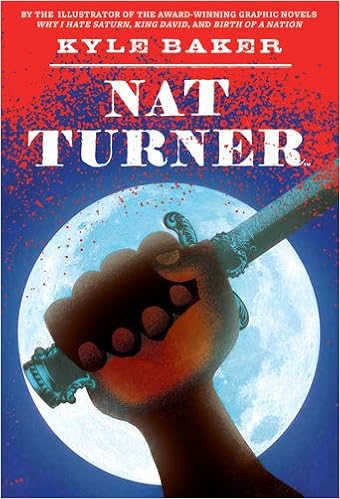
127) Nat Turner by Kyle Baker, finished November 10

This is an impactful book. It spends a long time establishing the horrors of slavery so when the brutality of Turner's revolt happen, no matter how awful it gets, you can't get those opening sequences out of your mind.

The book is largely wordless, but the pages with words are filled with Turner's own words. And there's a seriousness and an honesty---almost,
at times, a holiness---to his language that it's not hard to view him as a peculiar amalgamation of Joseph Smith and genocidal Joshua

The result is beauty in ugliness.

I'm in the middle of Tim O'Brien's "How to Tell a True War Story" and his explanations of how to tell these stories seem appropriate here.
The truths are contradictory. It can be argued, for instance, that war is grotesque. But in
truth war is also beauty. For all its horror, you can’t help but gape at the awful majesty.... Like a killer
forest fire, like cancer under a microscope, any battle or bombing raid or artillery barrage has the
aesthetic purity of absolute moral indifference---a powerful, implacable beauty---and a true war
story will tell the truth about this, though the truth is ugly.

To generalize about war is like generalizing about peace. Almost everything is true.
Almost nothing is true.
This comics recreation is a true war story.
two days


===========================================================


126) A Wind in the Door by Madeleine L'Engle , finished November 7

As far as storytelling goes, this doesn't match up with A Wrinkle in Time. The philosophizzing and whatnot has completely taken over the text. I mean---it was fine, I guess. Elements were quite nice. But it dragged, oh la how it dragged. Eesh.
over three months


===========================================================


125) Live Right and Find Happiness (Although Beer is Much Faster): Life Lessons and Other Ravings from Dave Barry by Dave Barry, finished November 3

Here's the thing about anyone my generation who rights funny stuff: whether we mean to or not, we all steal from Dave Barry. It's kind of a relief, frankly, to read this 2015 book and see he's still got it. I laughed aloud quite often, and the letter to his grandson was genuinely sweet and touching. And funny. Dave Barry, friends,
is still Dave Barry.

(Also worth mentioning: he explained soccer to me in words I understand. Although he didn't say this directly, essentially it is this: every soccer game is a pitcher's duel.)
couple weeks maybe


===========================================================


124) Munch by Steffen Kverneland, finished October 31

We went and saw the Munch show at SFMOMA. It was amazing. It was also amazing crowded, probably because we didn't make it until the closing weekend.
Because it was closing though, all the Munch stuff was on sale including this book for $12. If it had been under ten I would have bought it without thinking, but at twelve I thumbed through and saw too many boobs and penises and stuff to have it hanging around the house. So I went to the library instead.

The book's central conceit is that most Munch biographies have extrapolated way too much from the facts and turned Munch into a fictional character of the biographists' own imaginings. And so Kverneland decided that all the words in the books would be direct quotations from primary documents and the only interpretation would come through his pictures.

And what pictures there are! His characters are sharply angled---almost cubist---yet consistent and realistic. And this realism is a great choice for Munch because he too was realist but not. Plus, Kverneland does fun cartoony things like giving drunk people Xs for eyes. And he incorporates Munch's art, using his own artist's sensibility to show the development of Munch's style and compulsions.

This bio captured Munch for me and added to my growing enthusiasm for his work. My enthusiasm is unlikely to ever match Kverneland's. But it is catching.
two-plus weeks


Previously in 2017

2017-10-27

On RINOs (and other small political epiphanies)

.

I despise The PBS NewsHour, largely because it's a tv show so why the heck is it on the radio, KQED? It's a tv show! It's designed for tv and not the radio. Put it on the tv and not the radio. KQED. Gah.

Anyway, I've been reduced to listening to NewsHour a couple times this week and remarkable bits of politics came up a couple times.

For instance, following Jeff Flake bombing the Senate floor, NewsHour interviewed Senator Thune who said, essentially, Jeff Flake is a moral guy but the rest of us have more pressing concerns than morality. I'm barely exaggerating. Go to the transcript and ctrl+f moral.

Then today (transcript not up yet), either Shields or Brooks pointed out that, compared to European political parties, American political parties don't have clear identities of themselves. They take their identity from their presidential candidate. This is clearly true. Parties don't even decide on a platform until a candidate is selected.

It also explains the bizarre comment someone left me on Facebook recently. (Here's the OP on Twitter.) The comment I refer to was something about yeehaw let's get all those establishment RINOs out of there! to which the kindest thing I could say was Huh? (although that is not what I said). It's a dumb comment, I thought. The idea that Flake is a Republican in name only is pretty mind-boggling (to say nothing of the fact that it was a bit of a nonsequitur). But only if you consider the Republican Party as a party of ideas---and policies and goals associated with those ideas. If, instead, you consider the Republican Party as the expanded body of Donald Trump, then hell yeah he's a RINO. Good riddance.

This theory can also explain the last eight years of the Republican Party in the negative in which their entire raison d'être was to be anti-the Democratic president.

Which raises the question: are the Democrats now merely anti-the Republican president?

It's hard to tell. Certainly, I mean, they are. They don't have a very coherent set of thinking on display outside that point. However, Trump does seem to be a special exception and so it's hard to say. But for the last eight years were they the party of Obama? They certainly tried to be, I would say.

Whether this is a vote for the American system or for a parliamentary system, I'm not sure. I've spent my life railing for the need for multiple parties, but unless we enormously change our political system, that won't happen. Weirdly, as our system gets more and more polarized and, frankly, crazy, I'm less certain we should change it. I'm still working out all the reasons I feel that way.

ps: betcha i haven't ever written so much about politics in an october that wasn't a presidential year before; thanks trump!

2017-10-26

#s of 책s

.

121, 122, 123) Measure for Measure by William Shakespeare, finished October 26

This was fun to read with students. I can see refining this into a regular gig.
some noncontiguous days


===========================================================


120) Deceit and Other Possibilities by Vanessa Hua, finished August 24

This was the hometown's ONE CITY ONE BOOK this year and I decided to play along.
I'm glad I did. It's a terrific collection. Very literary if you're allergic to the genre, but beautifully well written with looks into bits of culture I live adjacent to but do not experience myself.

Plus: what a great cover.

Anyway, for those keeping score, I assigned the one about the Stanford nonstudent. The one I found most moving was the one about the gay couple. I was perhaps most interested in how she dealt with modern, lived, religious experience.

It's a short book. And well worth picking up.
TIME


===========================================================


119) Measure for Measure by William Shakespeare, finished October 23

This is some kind of messed-up play. I love talking about it. Hit me up sometime.
couple weeks


===========================================================


118) Glossolalia by Marita Dachsel, finished October 15

Here's the concept: Joseph Smith had a lot of wives. Let them each have their say.

Most of these poems fit into the one-dramatic-monologue-per-wife plan, but a few have a collective voice or are about a place; Emma gets multiple poems.

As a concept it's good enough, but it's a lot of poems and not really enough ideas to sustain the volume. It was hard to get through.

Here's the final stanza (from Eliza Snow):
There are many versions of the story,
& you should be wise enough to know
that truth is filtered through tongues.
over a year


===========================================================


117) Bowery Boys by by Cory Levine & Ian Bertram & Brent McKee, finished October 14

I think maybe the reason this book disappointed me so much is because the cover and title together are making a promise the story does not keep.


Looks like a rapscallion bunch of young characters fighting their way through old New York. Nope. They're there in all of the boroughs' blood and boobs, but they ain't what the cover suggests. This is more of a political history featuring fictional characters, maybe. The adults are more important, full stop. The kids are incidental,
even when they take the lead.

Anyway. Whatever.
several days


Previously in 2017

2017-10-12

Preliminary notes toward a perhaps-never-to-be-written monograph defining American liberalism and American conservatism, both their individual goals and how these should work together

.

One of the great thing about reading Jeff Flake's recent book was hearing conservatism defined by a thoughtful person for whom conservatism is a philosophically grounded means to thought rather than, you know, code for hating Obama or something. One of my complaints about American politics is that conservative and liberal are no longer words with clearly defined meanings but labels we proudly apply to what we like and viciously sling at things we don't like. I identify as a conservative (or a liberal) and therefore what I hate I will label liberal (conservative). It's childish thinking and grotesquely unhelpful.

Which is one of Flake's misfires. He does a good job defining conservatism and makes a strong argument for working with liberals, suggesting America is healthiest when ideas from both sides arrive, in compromise, to conclusions. However! The best definition he can come up with for liberalism is that it's about freedom-limiting big government and handouts. Not sure why that's a valuable viewpoint that deserves balance with your own carefully reasoned positions, Jeff.

Also, I've always felt that American conservatism is simply a form of liberalism. If you go back to classical liberalism---the Enlightenment, the birth of liberal thought--then we find that democracy is a liberal concept; the Constitution is a liberal document; freedom is liberalism. Until the alt-right, no American conservatives called for a return to feudalism or monarchy. Conservatism and liberalism, it seems to me, are not opposites. At least, certainly not in America. Other nations can define these words however they like.

And so, as I read Flake's book, I desired to find an Occam-like definition of these American political movements. Something simple, but something more fundamentally true than conservatives want a small government and liberals want a big government (it's nonsense to consider these goals rather than means to whatever the goal actually is) or liberals want to help people while conservatives want people to help themselves.

And I've found the solution. And the solution is simple because this is America. American liberals and American conservatives share the same goal: Freedom.

Americans desire freedom.

And here's the difference between American liberalism and American conservatism:

American liberalism works to increase access to freedom
American conservatism works to prevent barriers to freedom

From these basic stands, we can extrapolate everything else in American politics. We can see why liberals and conservatives gravitate toward types of solutions to classes of problems. (E.g., the stereotype that liberals want more laws and conservatives fewer.) We can also discover why liberals are prone to certain intellectual errors and why conservatives are prone to their own set of intellectual errors.

But, fundamentally, we can see why it's not just lip service to say we need both parties working together to arrive at the best solutions for our people. Because increasing access to freedom and preventing barriers to freedom are not identical, but they are both massively important.

Before I get to examples of how this plays out, I want to make two corollaries which are rather obvious is we accept my axioms but which need to be stated clearly.

First, no one's political feelings will be purely liberal or conservative. I'll have plenty of examples of this should I write the monograph, but considering health care should be enough to show how a simple antithesis can still lead to complicated arguments.

If you have health issues, your freedoms are necessarily restricted. If you have asthma, you can't run a marathon. Therefore increasing access to health care increases people's access to their Creator-bestowed rights. It's a liberal cause. But making people pay for insurance decreases people's on-hand money which decreases their freedom to spend that money as they damn well please. Conservatism. Thus we see the way health care is currently portrayed.

However, so-called Obamacare's entire structure was created by conservative thinkers (largely). How can this be? Because having health removes barriers to people's freedoms. That's why.

Anything that increases freedom can be pitched as a liberal or conservative cause. One might argue this makes my axioms useless, but no. What it means is that when we call ourselves a liberal or a conservative, we are pitching our tent with our cultural crew. Plenty of policies from both parties betray their key beliefs. But this is why the axioms are so important. When we talk not about liberal or conservative persons but liberal or conservative policies or principles or, most importantly, actions, then we can really stick to the point instead of getting distracted yelling about God or Russians.

It will also help us judge whether our parties are on the right track or not. Are the Republicans on the right track as of October 12, 2017? I dunno. Seems to me they're more about winning and supporting a president with authoritarian leanings than preventing barriers to freedom. I give them a D.

The Democrats? They're doing better, but I think reacting against a party that swore to make Obama one-term and denied him his rightful Supreme Court pick has made them crazy. Calls for single-payer health care seem a lot less about increasing freedom through health and therefore at least equally about distinguishing themselves from self-destructive Republicans. C.

A couple more notes on this before I go back to principles again.

First, their good intentions (freedom, whether increasing access or preventing barriers) lead both parties to predictable sins. Democrats might work to increase access to freedom even if it takes freedom away somewhere else. Republicans might desire to prevent barriers to freedom even if it places barriers to another freedom.

That these outcomes are possible is a fundamental thing to understand about the American experiment. And navigating conflicting freedoms is a fundamental job of the Supreme Court. I could pick a less controversial example, but let's rip something from the headlines, shall we?

The evil slaughter we experienced in Las Vegas must change the way we think about the Second Amendment. I'm not going to pick gun-control sides in this embryonic essay, but we at the very least need to admit that gun rights do not exist independently of our other rights. Today, it is reasonable to consider that any peacable assembly may be the target of someone who used their Second Amendment rights to prepare for an evil action. This is, in principle, the same as my freedom of speech conflicting with your right not be trampled, or any other weighing of rights. It's a free country because freedoms are curtailed in freedom-biased ways. Your freedom to not get stabbed is a more important freedom than my freedom to stab.

Gun control is an appropriate example of how liberal and conservative thought can work together to arrive at the best solution. But this is a longer argument and I'm already over 1200 words---way too long for a blog post.

So too more things I want to talk about come monograph time, and I'm out.

First, the ACLU. By my math, the ACLU sounds extremely conservative, working overtime to prevent barriers to rights. But the actions they take are proactive barrier-destroying which, to me, still sounds more liberal.

Second, one place Flake deliberately broke with Goldwater is with what Goldwater is best remembered for today, outside conservative intellectuals: his failure to support the Civil Rights Act.


This, I think is a healthful viewpoint. But it also opens a difficult problem. Because racist laws cast a much bigger shadow than most of us realize. For instance, my the city my in-laws grew up in was underwritten by the federal government to provide housing. If you were a veteran, you didn't even have to put down a down payment. And everyone got interest help. Business boomed and people had homes. This is why the American dream blossomed mid-century---the feds footed the bill.

But! All across America---yes, even here in the Bay Area---suburban areas like this were monetarily supported by the government of the United States of America if and only if those areas were explicitly white only. Which boggles my mind, but is a fact.

In other words, the reason white families have been building wealth at record rates since World War Two while black families have been stuck in aging prospects (#grossoversimplificationwarning) is because of, well, the government. It doesn't take much imagination to see that almost every crisis in America is no more than two degrees of separation away from this decades-long policy. It might be, in fact, too late not to involve government in almost anything, by Flake's estimation. In which case, perhaps conservatism's goals should be evening the playing field---refairifying America---in order to return to minimal interference? I dunno.

This as well needs more development, but I'm done for now.* This is enough to chew over. Please chew and help me improve my thinking.

American liberalism works to increase access to freedom
American conservatism works to prevent barriers to freedom

We all agree on freedom. Where do we go from here?

Historical reasons most American Mormons are conservative
Sex and law
Libertarianism
The Constitution is both liberal (defining a government) and conservative (the First Amendment / preventing ex post facto laws)

2017-10-11

A book from a sitting Senator
a book from one of America's great figures
and an extremely popular piece of crap

.

116) Conscience of a Conservative: A Rejection of Destructive Politics and a Return to Principle by Jeff Flake, finished October 11

Jeff Flake came to the House before the Tea Party, but I've always associated him with that crowd. And it wasn't until the last couple years that I became aware of him as anything other than [generic Republican]. Then he pushed back---firmly---against Trump. And I started looking around and paying attention and listening to him. Now I have an appreciation for the man and, having recently read and enjoyed Al Franken's new book, I decided to balance my diet with Flake's.

It was hard to imagine me, Theric,
reading two full books by two sitting senators in one year, but at least I would start it. But then it arrived and, hey, it's under 150 pages and, hey, it's well written. Compelling. Interesting. Largely fair and insightful. I ate it up.

Of course, having written a book about why being fair and insightful---honest---is part of the reason he will almost certainly lose his primary next year. But he's doing the right thing and I hope that keeps him warm at night.

Flake's book is modeled after one with a near-identical title by Barry Goldwater, Flake's Arizonan progenitor. Goldwater of course is remembered very differently by different people. Flake is a fan, but a clear-eyed fan. As part of his demonstration in favor of truth, he calls Goldwater on his sins---and calls himself on his own sins as well.

In fact, one thing that Flake and Franken have in common---at least according to their books---is a desire to state the truth and find political compromise honestly through a path paved with truth. I can't tell you how refreshing it was to read this from both sides of the aisle. In a world which seems cast from venomous polemic,
hearing people in positions of authority, both Democrat and Republican, call their own party out (while, granted, hinting the other side's even worse) and to call for more bipartisan work, warms the ol' heart cockles.

It's hard to look at 2017's Senate and think "functional," but for all the Garland-shaped horrors, there are bright spots of hope.

At least until Bannon's Senate is seated, I suppose.

In the meantime, we can share our faith in American priciples and idealism and move forward.
under two weeks


===========================================================


115) Stickeen by John Muir, finished October 4

My eight-year-old read and enjoyed this very much. So did I. This is a much more impressive read than most of the stuff he's picking up. It helps that we went to Muir Woods than the Muir House (where he let me buy this for him). It also helps that this edition is beautifully designed and illustrated.

Get your kids to read something a hundred years old with a philosophical bent and a cute dog. Pick up Stickeen.
fourish days


===========================================================


114) Ready Player One by Ernest Cline, finished October 3

According to the acknowledgments page in the back, this novel went through a plurality of drafts with much professional help to get it into its mussy final form. I almost wish I hadn't forced myself to finish the book and read this depressing fact.

Look: the plot's dandy and the worldbuilding is excellent. It's everything else that's crap. Here's a couple examples so you know what kind of blonkey goes on in this trash heap.

1. Two thirds of the way through the book, the protagonist needs to be able to play guitar well. He can! Guitar is never never mentioned anywhere else in the entire book.

2. The first time we meet the hero's best friend, Aech, we learn the hero usually calls him a random name beginning in H such as Hugh or Humphrey. This literally never happens again over the next 300+ pages.

These are egregious examples, but the book is rife with laziness and sloppiness and ugliness. It's astonishing to me that this is from a major press.

Sigh....

Anyway, Hitchcock said he would never make a film of Crime and Punishment because it was already perfect so why bother. But a good book? Or a mediocre book? That's where you find the source material for a great movie.

Which is just a way to say that I have a lot of faith in Spielberg. And his willingness to improve on this subject matter.


Okay, one more thing. You know what would have helped a lot? Ditching the first-person p-o-v. That's not a law of nature when writing a teenaged protag. And it would have forced Cline to solve a lot of the book's most pervasive problems.

Okay, done.
two weeks


Previously in 2017

Thbiblio

.

Since thmazing.com is down (and at risk of having to be bombed into oblivion as part of its salvation), I thought I would reproduce its list of publication credits here. It's the only clean list I have.

.

Novels
•Byuck (Strange Violin Editions 2012) *buy*

Novellas
•Perky Erect Nipples (Antemoff Ebookery 2015) *buy*

Short stories
•Armageddon, Burning, And, Hell (The Looking Glass 1994)
•Afterlife (Quantum Muse March 2006) *read*
•The Widower (Dialogue Paperless June 2007, Dialogue: A Journal of Mormon Thought Summer 2009) *read* *read offsite*
•The Oracle (Nossa Morte February 2008) *read*
•Happy St. Patrick's Day (Arkham Tales May 2009) *read*
•Blood-Red Fruit (with Danny Nelson, The Fob Bible 2009) *read* *buy*
•How Long Till Two Times (The Fob Bible 2009) *read* *buy*
•Along with the Rainbow (The Fob Bible 2009)  *buy*
•Solomon's Reprise (The Fob Bible 2009) *buy*
•Them Bones Them Bones Gonna—Walk Around (The Fob Bible 2009) *buy*
•Ezra's Inbox (The Fob Bible 2009) *buy*
•The Avon Lady (Pandora's Nightmare 2010; Faed 2015) *read* *buy*
•17 Facts About Angels (Irreantum Fall/Winter 2010) *read* *buy*
•Davey Dow and Lala (Wilderness Interface Zone October 2011) *read*
•The Legend of Boitown (Scars.tv May 2012; Children, Churches and Daddies August 2012; the Mission (issues) May-August 2012; After the Apocalypse: Prose Edition forthcoming) *read offsite* *buy*
•Lovely, Fearful Symmetry (Surreal Grotesque Magazine June 2012) *read offsite*
•Swallowing Bones (Windmills 2012 Ninth Edition) *buy*
•Stars Were Gleaming (Sing We Now of Christmas 2012) *buy*
•Maurine Whipple, age 16, takes a train north (Everyday Mormon Writer October 2012) *read*
•The Dancing Monkeys of Blackpool (Windmills 2012 Tenth Edition) *buy*
•Bearing Testimonies of Death (Lowly Seraphim 2013)  *read offsite*
•Laurel Wistian and the Adventure of the Dangerous Mice of Dr. Mortimus Alexander Fitzbottom, PhD, AlcD (Midnight Movie Creature Feature 2 March 2013) *buy* *read offsite*
•Do Not Open Until Christmas (Carol of the Tales and Other Nightly Noels 2013) *buy*
•Out for Santa (When Red Snow Melts 2013) *buy*
•The Great Mormon Novel of the 21st Century (Antemoff Ebookery 2013) *buy*
•Yes, Snow White Ate the Apple. It Was a Suicide. (MicroHorror January 2014) *read offsite*
•Then, at 2:30. . . . (365 Tomorrows February 2014) *read offsite*
•A Laurel's First-Night Fantasies (longlisted in Mormon Lit Blitz 2014, Dialogue Summer 2016)
•All Right, Have It Your Way – You Heard a Seal Bark (365 Tomorrows January 2015) *read offsite*
•An Excerpt from But Very Little Meat (Modern Mormon Men February 2015) *read offsite*
•The Naked Woman (Pulp Literature Spring 2015) *buy*
•Angry Sunbeam (Mormon Lit Blitz May 2015) *read*
•The Swimming Hole (Redneck Eldritch April 2016) *preview* *buy*
•Duties of a Deacon (forthcoming in Dialogue)

Chapbooks
•After Chadwick (Antemoff Ebookery 2015) *buy*

Poems
•Chores (From the Asylum June 2007) *read*
•Morning Walk, Spring 2009 (Wilderness Interface Zone March 2009) *read*
•Maher-shalal-hash-baz (The Fob Bible 2009) *read* *buy*
•Gomer (The Fob Bible 2009) *buy*
•My Latest Trip to the Berkeley Botanical Gardens (Wilderness Interface Zone February 2013) *read offsite*
•Rifflection: “To His Mistress Going to Bed” by John Donne (Psaltery & Lyre May 2013) *read offsite*
•Completely Static Account (3by3by3 June 2013)  *read offsite*
•Goal Stunning Goal (3by3by3 June 2013) *read offsite*
•God (Psaltery & Lyre July 2013) *read offsite*
•A Hymn for Mother's Day in Long Meter (first accepted to be published as part of "Our Mother Who Art in Heaven" in A Mantle of Stars December 2013; first published on A Mother Here) *read offsite* *buy*
•Sponsored Funeral (Quantum Fairy Tales May 2013)*read offsite*
•Amtrak to SAC (Psaltery & Lyre July 2013) *read offsite*
•Being a High-School Teacher Is a Great Disguise (Psaltery & Lyre August 2013) *read offsite*
•Accidentally Deleted (Quantum Fairy Tales October 2013) *read offsite*
•Overall Free (無μ November 2013) *read offsite*
•Rifflection on the Climax of “The Monkey’s Paw” (Passages of Pain, Lyrics of Loss February 2014) *buy*
•In Memoriam: B (Passages of Pain, Lyrics of Loss February 2014) *buy*
•The Young Amateur Imagines the Editor’s Pen, ca 1997 (Passages of Pain, Lyrics of Loss February 2014) *buy*
•Enough Is (The Poet's Haven March 2014) *read offsite*
•Solstice (Boston Literary Magazine March 2014) *read offsite*
•The Fiberglass Giraffe in Davis, California (Epigraph Magazine April 2014) *read offsite*
•Some seduction this— (Psaltery & Lyre July 2014, After Chadwick 2015) *read offsite* *buy*
•Jesus Fishing the Styx (Psaltery & Lyre August 2014, After Chadwick 2015) *read offsite* *buy*
•After Party (Psaltery & Lyre October 2014, After Chadwick 2015) *read offsite* *buy*
•Creator (Psaltery & Lyre November 2014, After Chadwick 2015) *read offsite* *buy*
•If I had a Book of Mormon Broadway show (LDS.net Poetry Contest Finalist February 2015) *read offsite*
•Vulnerability / Intimacy (Quatrain.Fish 2015, After Chadwick 2015) *read offsite* *buy*
•Sheep (have poetry) (After Chadwick 2015, forthcoming in Wilderness Interface Zone) *buy*
•Appreciation to the first poet (After Chadwick 2015, forthcoming in Wilderness Interface Zone) *buy*
•Doline (forthcoming in Califragile)
•El Niño (forthcoming in Califragile)
•If Joseph Smith Had Been Born in California (forthcoming in Dialogue)
•Domestiku (forthcoming in Dialogue)
•Sonnet—for Solstice (forthcoming in Dialogue)
•Sixth Mass Extinction Event (forthcoming in Califragile)
•Working Theory (forthcoming in American Journal of Poetry)

Comics
•Mormons by the Bay (SF Weekly Dec. 12-18, 2012) *read*
•Inappropriate Book Illustrations Redeemed through the Glory of Dance (Red Fez February 2014) *read offsite* 

Essays and Criticism &c.
•Living Literature (flashquake Spring 2007) *read*
•Saturday's Werewolf: Vestiges of the Premortal Romance in Stephenie Meyer's Twilight Novels (Reading Until Dark April 2009) *read offsite*
•Saturday’s Werewolves: The Doctrine that Makes Stephenie Meyer’s Lycanthropes Golden Investigators (Sunstone Magazine December 2009) *read offsite*
•How to Get Over It (The Fob Bible 2009) *buy*
•Communion with the Small (Wilderness Interface Zone July 2009) *read offsite*
•The Ambiguity of Excellence: Kazu Kabushi’s Daisy Kutter (Fantasy Magazine December 2009) *read offsite*
•Foreword (foreword to Cetera Desunt by Danny Nelson 2010) *buy*
•Space Opera 101: Jake Parker’s Missile Mouse (Fantasy Magazine March 2010) *read offsite*
•Annie & Kah Leong Poon (Mormon Artist April 2010) *read offsite*
•How to Become a Mormon-Comics Snob in Five Easy Steps (Sunstone Magazine September 2010) *read*
•Why Church Artists Owe Ric Estrada a Thank-You Card (Sunstone Magazine September 2010) *read*
•Pow! Zot! Amen!: Mormon Theology in Michael Allred's Madman (with Stephen Carter, Sunstone Magazine September 2010) *read*
•Ain't No Such Thing: Moving Beyond the First Series of The Lonely Polygamist Reviews (Irreantum Fall/Winter 2010) *buy*
•Orson Scott Card (Mormon Artist December 2010/January 2011) *read offsite*
•Monsters and Mormons and the Deseret Book (Monsters & Mormons 2011) *buy*
•The Bold Spirit of Bryan Mark Taylor (introduction to 200 Paintings by Bryan Mark Taylor 2012; introduction to Bryan Mark Taylor: Cities by the Sea 2013) *read offsite* *buy*
•Connecting the Generations through Disco: A review of David Clark’s The Death of a Disco Dancer (Irreantum 14.1 2012)
•Mormons in Comics (Mormons and Popular Culture: The Global Influence of an American Phenomenon 2012) *buy*
•Marital Matters (Antemoff Ebookery 2013)  *buy (free)*
•What if Mickey Mouse Isn’t Mormon? (Dialogue: A Journal of Mormon Thought Summer 2013) *buy*
•Our Mother Who Art in Heaven (published as an introduction to "A Mother's Day Hymn in Long Meter" in A Mantle of Stars December 2013) *buy*

•Luisa Perkins (Mormon Artist November 2013) *read offsite*
•Steven L. Peck (Mormon Artist November 2013) *read offsite*
•Denise Gasser (Mormon Artist February 2014) *read offsite*
•Seriously—Why the Hell Can't You Be More Like the Nelsons? (Sunstone Summer 2015)
•. . . then he was like, “Mind if I hang out here for a while?” (foreword to The Garden of Enid: Adventures of a Weird Mormon Girl, Part Two) *buy*
•Foreword (foreword to States of Deseret 2017) *buy*
•Something Outside the Temporal (Whale Road Review Fall 2017) *link*

Presentations/Panels/Lectures/Whatever
•Saturday's Werewolf: Vestiges of the Premortal Romance in Stephenie Meyer's Twilight Novels (Sunstone West Symposium March 2009; Life, the Universe and Everything Symposium February 2010)
•Mormonism and the Arts: Mormon Fiction (Berkeley Institute of Religion December 2009)
•Funny Papers: Sunstone’s Comics Issue (Sunstone West Symposium March 2011)
•Rehabilitating Nephi Anderson, a Mormon Norwegian-American Writer Lost to Assimilation (part of the panel "Nephi Anderson, Mormonism's Norwegian-American Novelist" at the Society for the Advancement of Scandinavian Study conference May 2013) *report*
•Mormon Culture and Comic Books (Salt Lake Comic Con September 2013) *view*
•Mormonism & the Arts: Poetry (Berkeley Institute of Religion October 2013)
•Mormonism & the Arts: Fiction, literary (Berkeley Institute of Religion November 2013)
•Mormonism & the Arts: Fiction, sf/f (Berkeley Institute of Religion November 2013)
•Monsters & Mormons: Reclaiming the Peculiar (Salt Lake Comic Con Fan Xperience April 2014)
•Representations of Mormons and Utah in Comics (Salt Lake Comic Con Fan Xperience April 2014)
•Sherlock Holmes in the 21st Century (Salt Lake Comic Con Fan Xperience April 2014)
•Mormons in Comics (San Diego Comic-Con International July 2016)

Plays
•Fuzzy Vision, Straight Aim (The Looking Glass 1994)
•Balaam's Sin (The Fob Bible 2009) *buy*

Positions
•President-elect (Association for Mormon Letters August 2016 – 2017)

Peculiar Pages
•The Fob Bible (primary editor) *buy*
•Out of the Mount: 19 from New Play Project (publisher only) *buy*
•Fire in the Pasture: Twenty-first Century Mormon Poets (initiator) *buy*
•Monsters & Mormons (co-editor) *buy*
•Dorian: A Peculiar Edition with Annotated Text & Scholarship (editor) *buy*
•States of Deseret (publisher) *buy*

2017-10-07

Tom Petty Counsels Us as He Leaves Us

.

Today in Las Vegas
they bathe in our prayers
but blood stains
are not
prayer-soluble.

And Wayne LaPierre,
a god since ’91,
grows rich
in the iron-rich soil.

But professionals will always
outlast damaged amateurs
or at least
so far that’s true.

Yet one voice cries,
an echo away,
Well, I won't back down
No, I won't back down
You can stand me up at the gates of hell
But I won't back down
Some look through blood
and some look through tears,
but with sweat we must stand
to declare
Well I know what's right
I got just one life
In a world that keeps on pushin’ me around
But I stand my ground

And I won't back down

2017-10-02

So
many
books

.

113) Paper Girls Volume Three by Vaughn/Chiang/Wilson/Fletcher, finished September 29

I kind of hate serial fiction. Now I'm supposed to wait? Ugh.

Yet serial fiction lives and dies by people reading it as it comes out.

No way left to love myself....
two days


===========================================================


112) Paper Girls Volume Two by Vaughn/Chiang/Wilson/Fletcher, finished September 28

Although not as mindblowing as the first volume, it also doesn't feel at all derivative anymore. It has shed any last vestiges of similarity as it has figured itself out and boldly being itself.

One great thing about this book is that I really don't know which group from the future is the good guys and which group from the future is the bad guys. I genuinely do not know. And that's great. Because it means the storytelling will keep me guessing and we may stay ambiguous all the way through. And that excites me.
two days


===========================================================


111) Artichoke Tales by Megan Kelso, finished September 26

This is a lovely, striking book. From the cover I was expecting something cutesy that belonged in the kids section. You might argue cute, but certainly not cutesy.
And it definitely doesn't belong in the kids section.


The sex, in fact, is one of the most mature aspects of the book. (MATURE in the dictionary sense, not the euphemistic sense.) Along with the violence and the politics and the family dynamics and the business and ritual and culture---the sex arises naturally from the lived lives of these characters. It's natural and functional and inevitable. It's life.

This is a book about collisions between the micro (me and you) and the macro (my nation and your nation and the drive of history).

If you don't mind monohromatic cartoon characters living fully realized lives---dirt and all---check it out.
four or five days


===========================================================


110) Adulthood Is a Myth: A Sarah Scribbles Collection by Sarah Andersen, finished September 20

Sometimes---you know how a comic can be great when you occasionally bump into it on Twitter or Facebook, but then when you sit down to eat a big happy lump of it it becomes repetitive and boring and kind of dumb? That's what happened here.

I mean---it probably didn't help that this collection was put together by theme like a gift book. Maybe if The Far Side had put out a book of, say, duck comics, we would have had a similar problem. Who knows.
one sitting


===========================================================


109) The Hunt for Vulcan: . . . And How Albert Einstein Destroyed a Planet, Discovered Relativity, and Deciphered the Universe by Thomas Levenson, finished September 19

I first learned about the planet Vulcan in a book of astrology I picked up somewhere. (You can get one too! Hurry! Only two copies left!) It was the first (and, to date, only) book by a serious astrologist I've ever read. It was fascinating---the mix of math and science with utter nonsense fascinated and delighted. It didn't convince however, and I didn't really ever think about Vulcan again. I rather assumed it was born of astrology and that was that.

Wrong. It was born of the fer-reals math and science!

My amateur astronomer friend with whom I viewed the recent eclipse (life-changing),
told me I must read this book as eclipses are frequent guest stars in the story of trying to understand why Mercury behaves so nonNewtonianly---the reason Vulcan was initially predicted, and problem left unsolved until Einstein rolled around. The book is written for someone with my capacity to understand sciences I didn't get to in college, and is thrilling intellectual fun.

I think I liked best though the final section with Einstein. A man who loved to think and who was willing to work through enormously blocking problems until he changed the world. But he simply succeeded. All the failures and missteps before him were usually not that at all. They were stumbles forward. I also really like how this book showed how Einstein was a man of his time and building from what his contemporaries were doing. No genius creates alone.

I do have one unanswered questions. The failed sightings of Vulcan---particularly the one by Watson---can they be explained by the increased bending of light near the sun that was later used to prove general relativity?
under a month


Previously in 2017