Showing posts with label what other people are saying about thme. Show all posts

2026-06-29

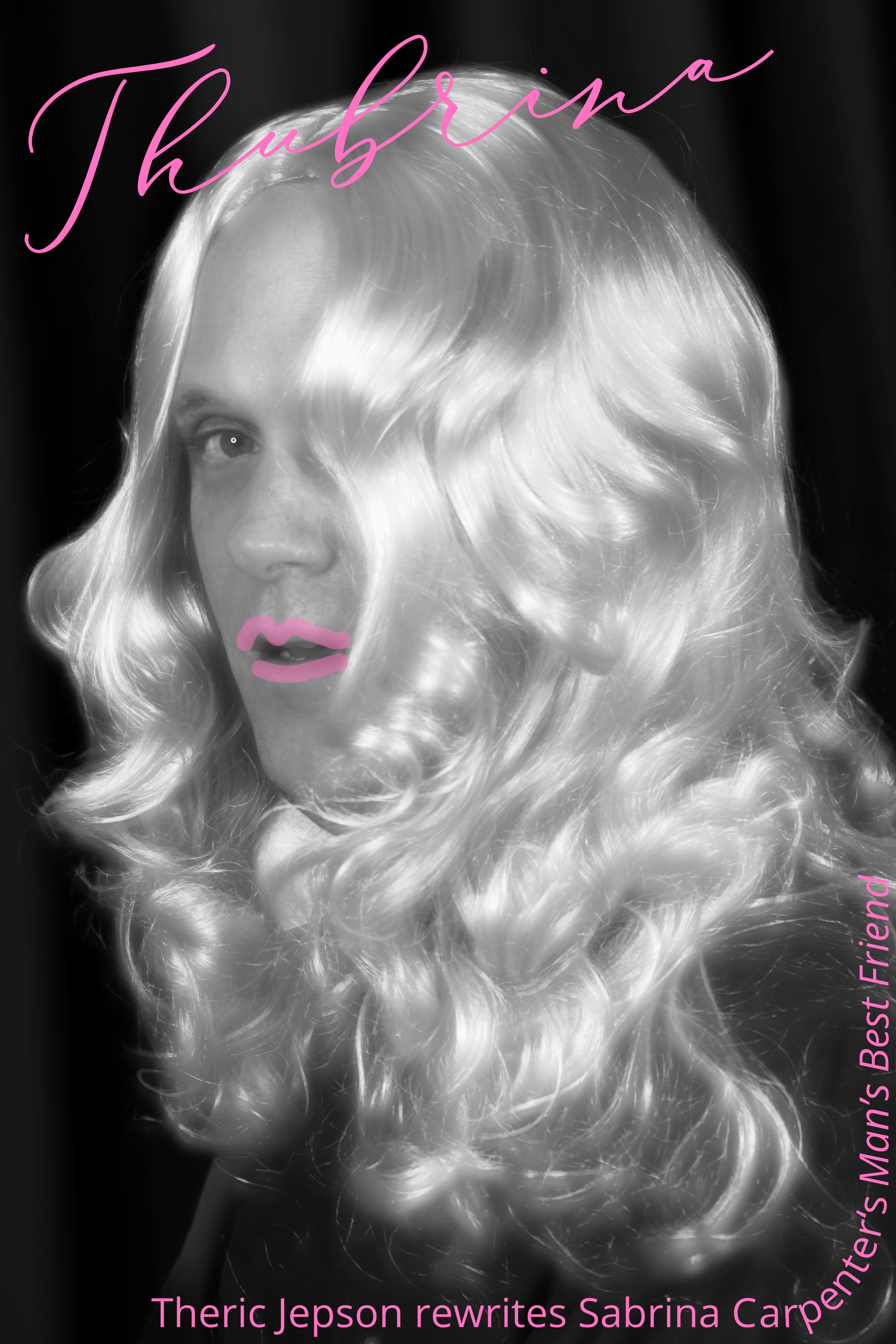
"The Uncanny Valley of Procedural Language: on Thubrina by Theric Jepson"
(reproducing a review by D.W. Baker)

.

I have a review of this reviewer’s book published on the same page. It’s a review-swap thing which is a cool idea. Although I misread the instructions and thought you had to give every book five stars. I was, like, what is this, Uber? But I went along with it. Who knows what stars mean anyway.

Really, the engine(idling is just a cool place to read and publish (see my “Were my band to play the Roadhouse” and “Glitter sifts from sky, sifts hell from beauty or beauty“) and I recommend checking them out.

This is the review:

Reading Thubrina, a bag of procedural tricks subtitled “Theric Jepson rewrites Sabrina Carpenter’s Man’s Best Friend,” is choosing to gaze into the uncanny valley: is this language poetry, or something else? Jepson’s tongue-in-cheek romp through the lexicon of Carpenter’s 2025 hit record comprises one 2,600 word story, 12 poems, 15 “oldtimey black-and-white-life-of-Jesus illustrations” (Jepson defines and explains this choice in the foreword: “Like Sabrina, Jesus was a carpenter”), and what might be considered the main draw of this book: a 16 page appendix with a detailed account of the methods used to generate each text.

Jepson’s command of procedural techniques is impressive. There are Dada games such as n+7 and v+7, in which every noun or verb of a text is replaced with the entry seven places ahead on a dictionary page. By applying the n+7 technique to the lyrics for “Sugar Talking,” Jepson offers readers phrases such as “Boy Scout, do you win a probabilism?” and “Yeah, your paralinguistics mean shiver to me.” There is a google translate algorithm (detailed in the appendix using 4 pages of arrow diagrams) which transforms the lyrics for “Manchild,” resulting in a sequence of uncanny lines: “The boy / Why do you always come to me? / The nest of my life. / Don’t you feel sorry for the innocent woman? / I never heard that be careful / Half of the brain was destroyed.” The book’s most imposing read is a short story designed to include every word from an alphabetized list of words from the original lyrics to “My Man on Willpower.” The text is a leviathan abecedarian of strange contortions, as in a fit of confused dialogue that accommodates four instances of “don’t” as they appear in sequence from the list.

Alongside such impersonal procedures, Jepson rounds out the collection with a number of poems that retain a subjective impulse. The crafting procedures of traditional forms result in one sonnet (using the lyrics of “Such a Funny Way”) and one villanelle (using the lyrics of “We Almost Broke Up Again Last Night”). Jepson also transforms lyrics using subjective semantics, such as “first deleting three words from every line, then [letting] it marinate in forgetfulness before returning to add three new words per line” (using the lyrics of “Don’t Worry I’ll Make You Worry”), as well as sonics, such as the poem which “attempt[s] to replace every word while keeping the meter intact” (using the lyrics of “Nobody’s Son”). The subjective encounter with language is also prioritized by Jepson’s choice to avoid listening to the album; according to the appendix, “he definitely will as soon as this book’s for sale.”

How does such an oddball, experimental work fare in the world of starred reviews? The readers most likely to award Jepson’s book a 4- or 5-star rating are those eager fellow travelers into language’s uncanny valley, in the tradition of John Cage and Jackson Mac Low, hoping to discern not only what animates the poem, but also what delineates it from inert text. Any unprepared readers—wayward Sabrina Carpenter fans, perhaps, or simply those expecting a more traditional poetics—are likely to award a 1-star rating. This review splits the difference to award 3 stars.

You can buy Thubrina many places, including Bookshop and Barnes & Noble. You can use your library card to access it through Hoopla.
 

2024-11-23

A sexy poem for your weekend

.

I just had a friend email me a compliment me for a poem that just appeared in Dialogue (the "image of pioneer homesteaders brought forward to the present intimacy of our bedroom is so powerful and beautiful and inspiring") and I haven't posted anything in the LDS Eros series recently, so I thought I'ld pitch it to you here.


2024-11-13

Phew.
or, Julie's first print review

.

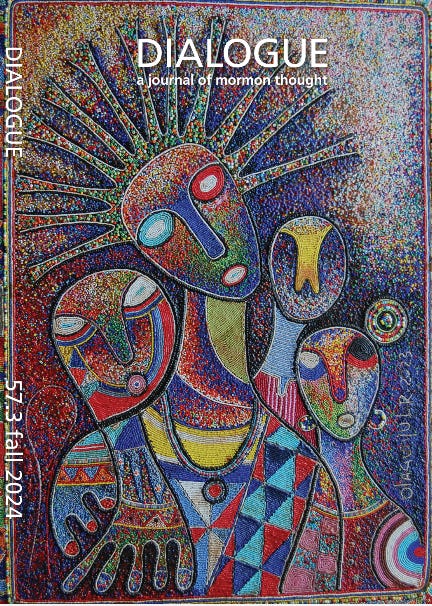
I got a whole stack of the new Dialogue in the mail today thanks to my poem in its pages.

You’ll like the poem. It’s sexy.

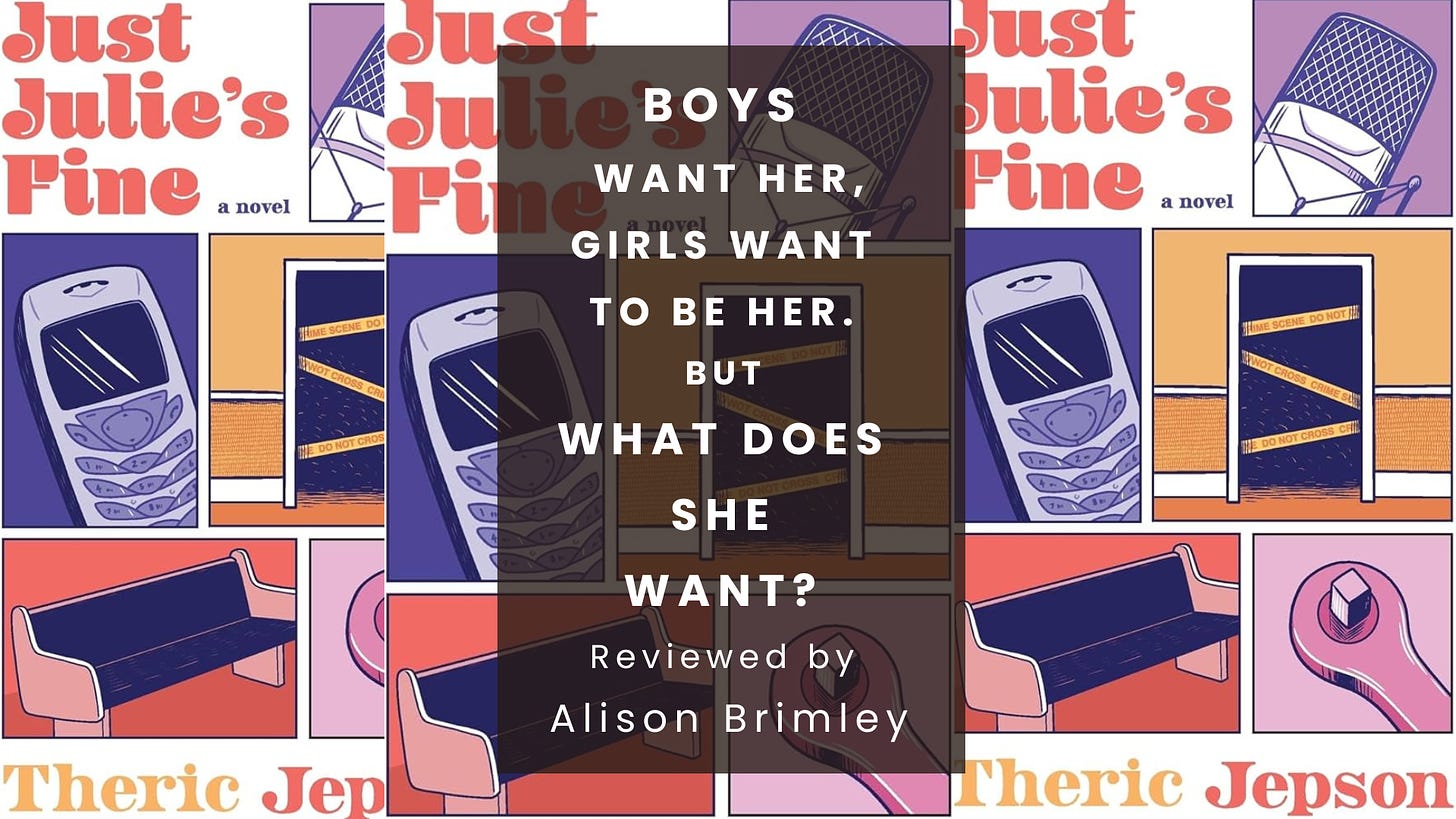
ANYWAY, I was flipping to the table of contents to admire myself in print (a natural impulse) but I landed in the toc’s list of reviews first and it was a long list! So I read that first. And what was the very last one, but a review of . . .Just Julie’s Fine.

Ever since Alison Maeser Brimley’s story “The Pew” appeared eight years ago, she’s been an artist to watch and so her opinion on Julie . . . would hold weight. I mean, if I were reading her review, it could well make or break my desire to read a book.

And let’s be honest: I wrote a book with so many landmines that the odds of me screwing it up or angering people were always high.

So it is with perhaps more relief than joy that I share with you that Alison gave Julie a positive review!

Phew!

Anyway, see what she has to say then pick up a copy or ask your library to do it for you.

(If you need even more convincing, Julie J. Nichols wrote the very first review of Julie and it’s also pretty persuasive. You’ll know this Julie from her genuinely hilarious review of Byuck.)

2022-02-08

Thelf-promotion, at which I am very bad

.

I was thinking about a tweet an hour ago and realized that, the short story it mentions, I have absolutely failed to promote in this space. Which got me wondering what else I'm overdue to mention. So here are some things.


Lucky Wounds

You can see why the tweet remains on my mind. Another friendly tweet describes the story as "an old gunman doing movies, thinking about past wrongs" and I think that about covers it. It's not very long! You've got time!


Still in that Moment

After I realized it was a little late in the season to promote a Christmas anthology, I decided to wait until next November. Which almost guarantees I'll forget to do it in 2022 as well. So let's throw it out now.

This is a kind of story I've long wanted to add to my repertoire. But I'm hiding my hand for as long as possible as to what kind of story it is. And so I'm not sure how to promote it since I don't want to even give you its genre.

Fwiw, not only is this one of the rare pieces of thephemera my father has read, he has been effusive in his praise. Apparently, this is exactly his favorite kind of thing?


Today I Will Comb My Hair

I don't write poetry in wild shapes and yet I still have a hard time getting them to look right on websites. What a difficult life I lead.

I wrote the poem about some climate news. It's not super-Mormony but I'm glad Bristlecone Firesides gave it a home. It feels like the right place.


(the bees of course don’t know it)
zzyzx road

Speaking of stuff that's not super-Mormony but is environment-minded, these two poems appeared in a really cool collection you should all most certainly pick up. It's loaded with terrific writers.

These two poems are autobiographical, referring to incidents, respectively, about fifteen and twenty years ago. Also, they both involve driving in California. So if you love poetry and you love driving in California, wow are you in for a treat.


Genetic Isopoint, Gentleman Broncos, and Thou

I've been digging the resurrection of Ships of Hagoth and I'm delighted to finally write something for them. The title, I think, covers it. If you love genetics, weird movies, and/or yourself, swing by.


How to Read Grace Like Water

Just remembered I have already promoted this one. Good for me.