2025-12-31

So this is it (doo wop)

.

It's 12:08 pm on New Year's Eve and I don't see any books lying around that I'm likely to finish by midnight so I'm calling it at 117 books in 2025. So a pretty average year, I think:

2007—90
2008—124
2009—108
2010—62
2011—94
2012—82
2013—129
2014—103
2015—126
2016—66
2017—144
2018—116
2019—100
2020—115
2021—131
2022—145
2023—136
2024—129
2025—117

Anyway, who cares. That probably better predicts how many comics I read than how intellectually stalwartly I lived.

Next year will be the twentieth (!) year I've engaged in this process. Which is not an easy number to understand. I guess the next big one after that will be when I've been doing it half my life.

But I try not to think about this too much because what I wouldn't do to have lists of the books I read before I began all this. What did I read that I don't remember when I was eight or ten or fourteen or twenty-seven?

Well, it's fine. Someday we'll all shuffle off to that great night bookmobile in the sky and that will be that.

One my favorite writer died in the past week, one who's only appeared once in one of these lists but who I've written and spoken about plenty over the years (example). We just watched his funeral and parasocial relationships may be strange but they can be healthy.

Next up: another year. It should look a little different. I'm curious what number it will end at.

112) Giant Days: Volume Two by John Allison with Lissa Treiman and Max Sarin, finished December 3

If this had been volume one instead of volume one, I would not have read volume two. It's fun enough but it's really just sitcom logic at this point. Characters gain skills as needed so an issue's plot can be executed and then those traits are lost, ne'er to be recovered.

I already checked out volume three so I may well read it, but . . . I have a lot of other stuff checked out too. So we'll see. 

two or three days 

113) Taproot by Keezy Young, finished December 19

This book seemed like it was going to be one of the queer-friendly nonstories that's flooding the market at the moment, but I'm happy to say it did have a story and, above that, it wasn't normal boring pre-formed plot, either. The love story was on a different set of rails from the horror element which, as it ends up, wasn't actually horror anyway. The story set me up to expect some of the same tired crap I feel like is everywhere (the comics I have not finished, yall) but it's playing a much higher level of game and I respect it.

(Incidentally, checked this book out of the library because it didn't have Keezy's latest book which was promoted on a best-of-2025 list.)


Anyway, the story's about a fellow who can see ghosts (one of whom is in love with him) and the unexpected problems that infect reality when you can, in fact, see ghosts. 

one sit 

114) The Last Flower by James Thurber, finished December 20

I own so much Thurber. But this may be the simplest way to understand his beauty and melancholy.

Of course, most people are just looking for the jokes.... 

one go 

115) Bowling with Corpses & Other Strange Tales from Lands Unknown by Mike Mignola


This might be my favorite Mike Mignola book. I'd have to look through old reviews to check, but I love this new world he's created and the anthology of stories that fit into it. I love his loose and ragged art—a sort of studied sloppiness that only someone who has mastered his craft can pull off. At the back of this volume is an alternate version of one of the stories that is just in his black and white without Dave Stewart's colors and it's a marvel to behold. The man uses so much ink.

One useful way to consider Mignola is how he deals with the beautiful and the monstrous. For instance, his nudes—there are naked women in this books; some are likely beautiful some maybe not, but it is their interiority and their abstract existence of shadows an life that define them—not the curve of a breast. And on the opposite scale, sight horrifying and unpleasant too are defined by their context and their abstracted qualities.

I hope many more of these volumes appear. 

If for no other reason than for more commentary from ducks and cows.

 about fifty hours 

116) Initial D Ominbus 1 by Shuichi Shigeno, finished December 25

I first heard of this on the Comic-Con floor where I picked up a promotional image because the kid looked like me in the Nineties and his car looked a lot like my first car, an '87 Accord.


Anyway, I didn't see it out, but I've been curious about it ever since and so when I saw this 500pp opening at the school library, I grabbed it to read over the holidays. Manga speeds by, after all, even something this thick.

It's about what I expected in that its mostly adolescent and post-adolescent boys racing cars. I like the blase hero who became a master at the drift in a way that keeps him from appreciating his awesomeness. It ends just before his second big race and it was all pretty exciting stuff.

My main complaint is the way the female characters are treated in the book. It feels rather like Shuichi Shigeno included them only because it's a rule and not because he wanted to. There's only one female character of note and this very boy-friendly book has one panel that for any redblooded heterosexual 14yrold will not only, necessarily, be a pornographic event, but will likely remain so for months, years afterward. It's very hot. I wanted to include that panel here so you to can be shocked at to its inclusion in what is other words a very kid-friendly book, but in the end decided it might do the same to my blog that it did to the blog.

But that's not the worst thing. This pretty high-school character is largely written "fine" EXCEPT (and it's a big EXCEPT) that in an underexplored subplot she's the victim of an Epstein-like character. She seems blissfully unaware that there's anything untoward about accepting large amounts of money from a rich old "dad" for getting naked in hotel rooms. I suppose in another thousand pages or so her honor will be defended by the series' hero (unless the series forgets her existence by then which, honestly, seems more likely), but for now the whole thing is a bizarre extra piece left in the box.

Looking for the right image to include (I didn't find it) I learned that this manga began back in the mid-90s and has become an anime and, twenty years ago, a live-action movie. So with luck we can chalk the disrespect given femanity to a former time, but man. It's wild that this was apparently the only way they could think to add a feminine aspect to a boy book. Woof. 

three or four days

117) Giant Days Volume Three by John Allison and Max Sarin (et al), finished December 27

Happy to say I liked this one much more than volume two. The writing has picked back up and the expressiveness of the art is delightful. I've come to like these three girls quite a lot and wish them well. Which is exactly why I've carved out a possible exception for them in my no-library-books-in-2026 rule

perhaps a week 


Previous books of 2025
(and years more distant)

2025-12-28

Hope, Jesus, and the New Year
(a svithe)

.

When you're the only person in town on the last Sunday of the year, you get to speak in church. 

.

The Old Testament is often reduced to its most exciting stories. It’s a big book and we don’t have much time so let’s create the world, part the Red Sea, kill a giant with a rock, and get on with our lives.

And I do love the flashy stories. When the Jews are abducted into Babylon you get Shadrach, Meshach, and Abednego standing with someone like a son of God in flames so hot the men who’d thrown them in were killed. Their buddy Daniel, later in life, gets thrown to lions. His friend the king is relieved and grateful to Israel’s God that Daniel survives the night—and then killed those who got him thrown to the lions in the first place.

That exile was only seventy years long but it looms large in Jewish memory. When Matthew gives the genealogy of Jesus he notes that “there were fourteen generations...from Abraham to David, fourteen from David to the exile to Babylon, and fourteen from the exile to” baby Jesus.

By the end of the Jewish exile, Persia had taken over Babylon, but the reputation of good people like Shadrach, Meshach, Abednego, and Daniel seems to have carried over to the new empire. A Jew named Nehemiah was one of the new king’s closest associates, his cupbearer. Cupbearers were deeply trusted by and intimate to the king they served. In a time of daily violence, a king’s life was only as safe as those closest to him. Nehemiah kept the king’s food safe, would even eat it first, as needed, willing to lay down his own life to preserve the king’s.

Nehemiah and his contemporary Ezra will only get one week of our attention next year in Come, Follow Me, but I was reading a nice little thing on this Protestant site about how Nehemiah is a type for Jesus; and their first point was about his cupbearing:

The book starts with Nehemiah as the cupbearer to the King. Such a position allowed him to sit at the right hand of the King, as he had to drink the King’s cup to test it for poison. He therefore had to be willing to die for the King if necessary. Like Nehemiah, Jesus dwelt at the right hand of the Father, and was willing to drink the cup the Father had for him, even though it meant his death.

But that’s just the beginning. Nehemiah, like Jesus, weeps over the condition of his people. Nehemiah, like Jesus, leaves the king and travels to Jerusalem to help his people reestablish their city and their temple and their faith. Nehemiah, like Jesus, then returns home to his king; during his absence from Jerusalem things fall apart and he has to return to reestablish the right way of doing things.

Studying Nehemiah’s life can teach us a lot about what it means to take on the name of Christ and to live the way he would have us live.

But Nehemiah’s story doesn’t have any fiery furnaces or lions’ dens. He never parts a sea or kills a giant with a rock. The books of Nehemiah and Ezra are more about dealing with rival politicians and building permits and scheduling conflicts. Neither of them is a prophet. They do know prophets but the prophets are always giving them poetic advice that doesn’t really solve the problem of where to source enough rock for both the temple and the city walls. Their city is post-destruction. It’s peopled with the poor and the desperate. They need to serve the least of them at the same time they’re accepting shipments from a king returning Israel’s stolen temple artifacts. Their days were confusing and unclear. They did their best, but couldn’t always be sure their best was best.

Sound familiar?

Today’s sacrament-meeting topic is Hope, Jesus, and the New Year and I think Nehemiah—his name means God Comforts—offers a good example for us to consider.

After all, when the Jews returned to Jerusalem, they recommitted themselves with an oath to obey what they knew from their scriptures, from the Torah. And the Torah, as I just read from a couple rabbis, “is the method of achieving hope…it embodies the principles and pathways that sustain hope.” And, once obtained, Jews don’t “lose hope because, even when waiting for goodness to emerge, a Jew refuses to give up working to create goodness—which in turn sustains hope.”

Hope, Jesus, and a New Year.

This year is ending. A new year is being born.

Every new day follows the death of the day previous.

The world is always being unmade: empires fall, cities crumble, babies become children become parents—and the world is always being created: empires rise, cities are built, babies become children become parents.

Sometimes is it easier for us to see what we are losing. Other times we more clearly perceive what is arriving.

But Jesus wept with Mary and Martha because the things we are losing matter. They matter a lot. Those relationships and events and beliefs and dreams were created to matter. And they matter still. And now they are gone.

The longer we live, the more things we lose.

Mikhail Bulgakov wrote, “Everything passes away…but the stars will still remain when the shadows of our presence and our deeds have vanished from the earth. There is no one who does not know that. Why, then, will we not turn our eyes toward the stars? Why?”

Perhaps it’s appropriate that we celebrate New Year’s at the darkest time of the year, when the stars shine their eternal shine most clearly, so we can witness the oldest creations remind us that creation is ongoing, that creation never ends.

The bit of poetry I always think of when hope comes up is Emily Dickinson’s “Hope is the thing with feathers.” I don’t have the rest of it memorized, but here it is:

“Hope” is the thing with feathers –
That perches in the soul –
And sings the tune without the words –
And never stops – at all –

And sweetest – in the Gale – is heard –
And sore must be the storm –
That could abash the little Bird
That kept so many warm –

I’ve heard it in the chillest land –
And on the strangest Sea –
Yet – never – in Extremity,
It asked a crumb – of me.

Hope as a songbird. Something small and fragile with hollow bones and only ounces heavy. Yet it sings its tune and never stops – at all. It sounds sweetest in the sorest storm, the sort of storm that should batter and destroy things small and fragile. Yet in the chillest land and the strangest sea, on it sings, on it sings, on it sings.

Hope is the thing with feathers.

And it flies alongside us in the sorest storms and chillest lands and strangest seas.

I’m inspired by a former sister missionary, Judith Mahlangu of South Africa, who once told President Holland, “[We] did not come this far only to come this far.”

Here we are at the edge of a new year. If we look, we’ll see plenty of things ended—or ending—or maybe ending.

But listen for the song of hope—the thing with feathers. Let it perch in your soul. Listen to it sing the tune without the words – and never stop – at all.

Paul asked, “What is our hope…? Are not…ye in the presence of our Lord Jesus Christ…?”

Paul told us, even “in this present world; [to] Look for that blessed hope…our Saviour Jesus Christ; Who gave himself for us.”

Jesus Christ, who gave himself for us, is our hope.

When cast into the fiery furnace, Jesus Christ is our hope.

When thrown to lions, Jesus Christ is our hope.

When building a city wall from ruins, Jesus Christ is our hope.

When dealing with an obnoxious neighbor, Jesus Christ is our hope.

When puzzling over the words of prophets, Jesus Christ is our hope.

Whether on the chillest lands or the strangest seas, Jesus Christ is our hope.

As one year ends, Jesus Christ is our hope.

As another year begins in the darkest part of the year with faraway stars obscured by rain clouds, Jesus Christ is our hope.

Maybe our lives feel more Nehemiah than Daniel, but whether our troubles are municipal squabbles or ravenous beasts, Jesus Christ is our hope.

Nehemiah didn’t live the sort of life that gets epic films made of it, but he did his best—and now you can get online and read about him—Nehemiah!—as a type of Christ.

As the new year begins, whenever you need Jesus in your life, come to church—this room is filled with Nehemiahs dealing with their own rock-sourcing issues and rival governors—each one a type of Christ as they live their life in faith, having taken the name of Christ upon them.

When we were baptized and took Christ’s name, one life ended and we were buried in the water. But then we were resurrected out of the water into a new life. Endings, beginnings; old, new; death, resurrection.

But, as the Latter-day Saint philosopher Adam Miller wrote, “Resurrection doesn’t solve [the problem of things passing away].... Resurrection doesn’t freeze the world in place.... Resurrection is the promise that, in Christ, life can continue to pass, not that it will finally stop passing.”

And that’s why, in the new year, as we look to Christ, our hope can’t be based on an end of ending. That won’t happen. Instead, let’s base our hopes in Christ and his promise that he is with us, that creation continues in our lives, that on the chillest lands and the strangest seas and during the most pedestrian of hardships, we matter to him, he remembers us, and the song of hope continues in our souls.

Moroni taught us that “whoso believeth in God might with surety hope for a better world, yea, even a place at the right hand of God, which hope cometh of faith…which [faith] would make them sure and steadfast, always abounding in good works....”

That’s what we can give each other in the new year. Hope—lives lived by hope—strengthening the hope of others.

And “what is our hope…?

“Are [ye] not… in the presence of our Lord Jesus Christ…?”

Look around.

Yes. You are.

In the name of our hope, in the name of our brother and our fellow-traveler, in the name of Jesus Christ, amen.

File:Wishing You a Happy New Year, from the New Years 1890 series (N227) issued by Kinney Bros. MET DPB874638.jpg 

previous svithe on thutopia / thubstack

2025-12-26

Books I will not finish in 2025
(or 2026, for that matter)


.

I think about doing this every December, but I’m a-gonna hold myself to it in 2026 and not check out any books from the library. I’m going to stick with the books I own—which includes literal thousands of volumes I’ve never read. I’m overdue in my own house and that needs to change.

Because of that, I’m returning all the library books I currently have, finished or not. But this declaration of bankruptcy requires some itemization. So lets get to it.

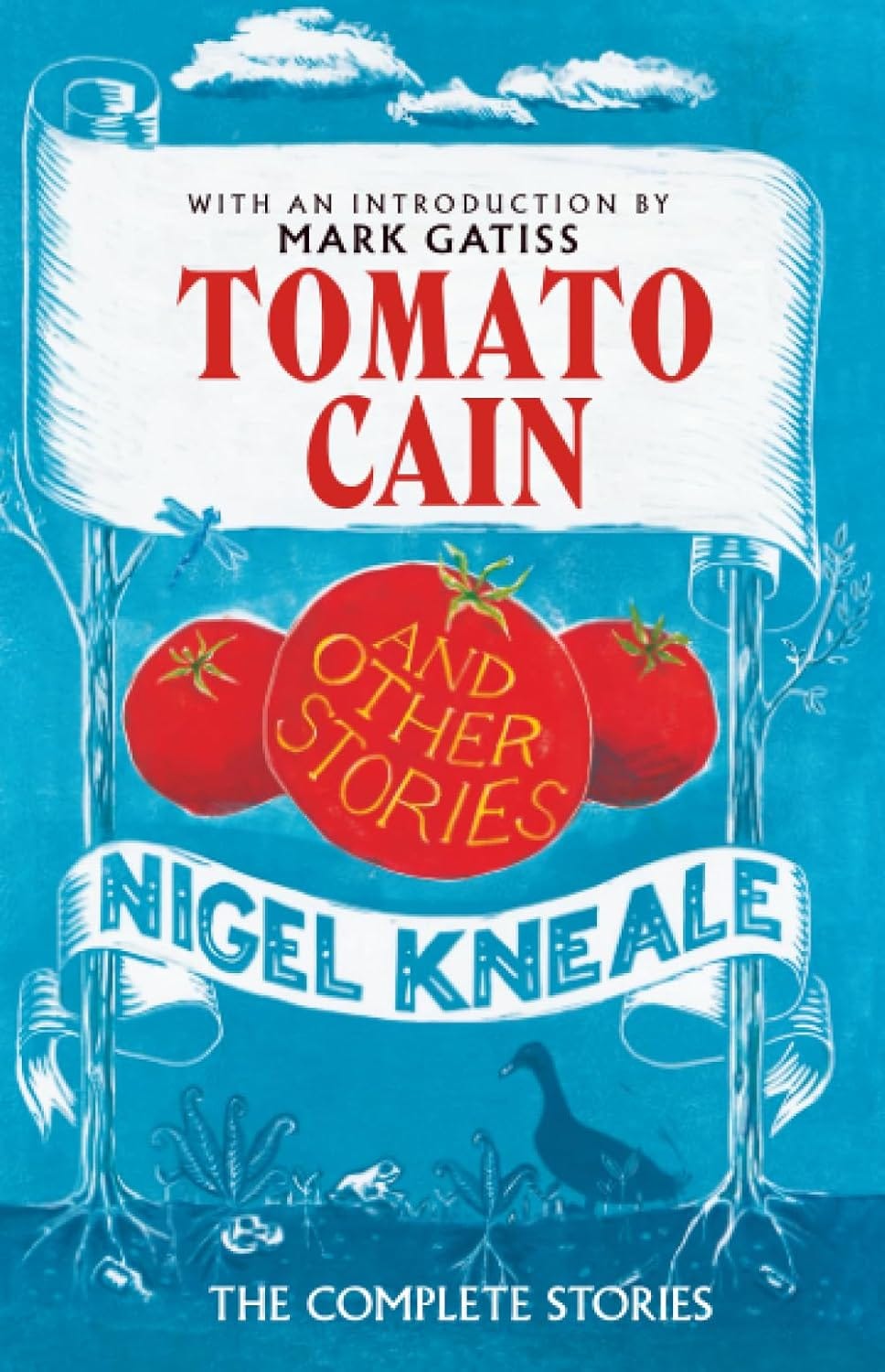
Tomato Cain and Other Stories by Nigel Kneale

I was turned on to this author by a Bulwark essay and while I don’t usually make it through short-story collections I really wanted to this time. The ones I did read were varied and intriguing. I didn’t get to all the stories I had been warned were most sticky but the opening story, the title story, one he said was an outlier, is seeming like one I will never forget. It’s about a religious man in a small town were tomatoes have never been seen before and how his conviction re his own righteousness leads to his being brought low. It may not be anything akin to traditional horror but it’s playing by the same rules in a completely different field. Like playing hockey on a tennis court.

Cat Ninja: Cat’s Claw by Matthew Cody et al.

This is a kids book in the worst way. It has dumb charm, sure, but . . . I don’t need to finish it. One-point-two of the stories and a skim of the rest was plenty sufficient.

Narrative of the Life of Frederick Douglass by Frederick Douglass

I had been reading this at school. I had a bookmark in one volume of a class set that had been sitting unused in a copyroom for most of a decade. But then someone decided to teach it, I guess, and removed all the copies?!?! But what about my clear plastic bookmark!?! Anyway, I checked out a new copy but I just don’t like it. I want my old copy back. So I guess I’m willing to wait.

Brother Brontë by Fernando A. Flores

I’ve checked this out twice. I’m fascinated by this dystopian Texas border town. I’ve read the first couple pages and know I want to finish it, but it keeps getting pushed aside. Let’s see if I’m still interested in 2027.

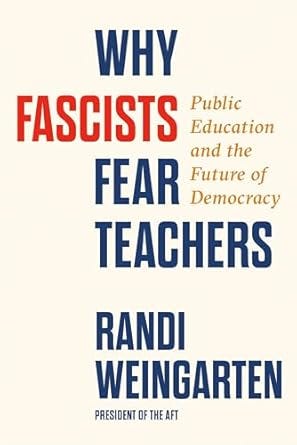
Why Fascists Fear Teachers: Public Education and the Future of Democracy by Randi Weingarten

This is a great little book for those who’ve never thought about what teachers actually do, but I have to say it feels a little redundant to me who lives it every day. The book covers four main things teachers do that fascists hate and they string together some quotations and old speeches (or so it feels). But it’s a quick and easy read and if you don’t recognize the disguised attacks on American public education, it’s an excellent introduction to our now. Here are the four things we teachers are up to in the bright lights of the classroom:

• TEACHERS TEACH CRITICAL THINKING

This is the thing that surprises me most about right-wing anti-teacher commentary, this idea that teachers are out to indoctrinate people. I suppose there’s some of that but really what most people who stick with the profession care about is kids thinking for themselves. And that itself is a concept many find dangerous. But if you’re ideas are so fragile and/or wrong that careful examination will destroy them, perhaps they deserve to be destroyed.

But then, I am a teacher.

•TEACHERS FOSTER SAFE AND WELCOMING COMMUNITIES

Not all teachers succeed at this but rare is the teacher for whom this is not a primary goal. No one can survive in this profession without caring about humans. And once you start caring about humans, it’s hard not to want to make things better for them. That starts with individuals in your classroom but as your eyes open it spreads to each student’s family and communities as well.

• TEACHERS CREATE OPPORTUNITIES

This is one of the hardest things about being a teacher because she’s right—we want to give our students opportunities. But this is one of the easiest things to take away. Visiting museums and historical sites and cultural events and competitive academics—these things take money! And money is the easiest thing for antiliberal culture warriors to take away. Even in California essentially limitless money, redirecting it from private pockets to a better future is a hard sell. But we do what we can. Most of my field trips have been walks to the cemetery....

• TEACHERS BUILD STRONG UNIONS

This one I think is perhaps the most understood and least appreciated. I grew up in red towns and know perfectly well that unions are the enemy of good people everywhere. This feeling is the result of concerted effort by powerful people with lots of money over decades and decades (and, to be fair, some bad behavior by some unions in years past). But when you listen to people’s complaints about unions, it’s generally a real crabs-in-the-bucket–type situation. Why should teachers have a thing I don’t have? is a fair question, but the answer isn’t take it away from teachers; the answer is you deserve that thing too. But it’s in capital’s best interest to push AI on you rather than give you fully covered health care. That’s why unions in the public space have to push the conversation forward. And you—whoever you are, whatever you do for a living—start imagining a world where you too have access to collective bargaining. We are the ants.

Why Fascists Fear Teachers: Public Education and the Future of Democracy: Weingarten, Randi ...

Uncle Silas by Joseph Sheridan Le Fanu

I’m so intrigued by this spooky Victorian mystery. But it’s long and a library book. So....

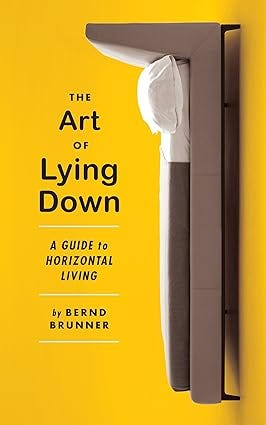
Art of Lying Down: A Guide to Horizontal Living by Bernd Brunner

Here’s a way to make a living! A bunch of short essays that have a fact or three so they count as educational but are so simple as to be difficult to neither write nor read.

The Art of Lying Down: A Guide to Horizontal Living

I really like the book cover and if I owned the book I would finish it—nice short essays before bed (and on topic, to boot!). But with a due date, it’s just not worth it.

Cry When the Baby Cries by Becky Barnicoat

This little comic about motherhood is one of many from this best-comics-of-2025 list I tried to track down. Lady Steed’s currently reading it and if she recommends it to me, I probably will as well. But short her ringing endorsement, I’m afraid it will be a casualty of my good intentions.

And then? And then? What else? by Daniel Handler

I checked this writing memoir out the same day as one of my favorite books read of 2025 and I experienced a bit of whiplash simply because they are so entirely different.

I love David Handler and I like this book a lot. I actually have emailed me which essay I left off on so I can return to it some day.

But it’s not a book I need right now and so we’ll let it go.

Poems by Charles Baudelaire

I checked this out because Handler loves Baudelaire. I get why he does but this set wasn’t pulling me in. Let’s blame it on the translation.

So will I stick with this goal of mine?

Back in 2007, I decided to only read books I’d already started. That felt great, honestly, but I didn’t attempt to stick with it for an entire year. In 2016 I attempted only started books (with a couple planned exceptions) for the full year. I finished the year with only 66 books (the 66th a clear violation of the rules) and no mention of this plan.

BUT THIS IS DIFFERENT.

Sure, I’m four years into The Stand (enjoying it but it’s LONG book) and I still haven’t finished Don Quixote (lost my copy)—not to mention the dozens (probably) of other books that I’ve started but haven’t finished—and so could make that my goal again. But what I really want to do is start books I own. There is no limit to genre or time period sticking with my own books, but I do think the publication dates will skew longerago when I stay home.

But I don’t know! It’s an experiment!

I have already delayed all the arrival dates of books I have on hold at the library except this one (coming November) and comics from that list I mentioned that the library hasn’t purchased yet. I may give myself permission to continue reading Giant Days if my time in the high-school library encourages it (and if book three [in process] doesn’t annoy me as much as book two [review coming next week] did). The main thing is no big new commitments. Something that can be read in a couple hours, okay, maybe, but no Brother Brontë with it’s 352 pages.

I’m curious how disciplined you all are with your for-fun reading. Do you chase the newest butterflies? Are you religiously checking off a list you made your freshman year of college? Do tell!


2025-12-18

Turn it up to one hundred eleven

.

My eleventy-first book's a spot of manga, but on the journey there we do some popular litcrit, some drama, some Dave Barry, some Austen sequelry, and lots more comics, only from the English-speaking word.

The good news is, it's not too late to ask for one of these for Christmas. 

.

102) How to Read Novels Like a Professor by Thomas C. Foster, finished November 18

It's hard to tell from the review, but I was pretty ecstatic when I read Foster's How to Read Literature Like a Professor a decade and a half ago. And I've been repeating that ecstatic review (and perhaps getting more ecstatic?) ever since, to get high school kids to read it. And now I've finally read another in what is now a decent-sized series.

This one feels much more high-brow to me. I can't imagine making an entire class of students read it. Individuals? Sure. Some would take to it. But not everyone.

I enjoyed listening to Foster talk about books he likes, but I don't think I liked it nearly as much.

But I say all this having underlined almost the entirety of chapter 12 and thrusting notes into the margins about what to make students do with his rant on sentences.

And if you move through my copy you'll find lots more marks than just that.

And then there's all the snippets I added to Wikiquote including three on this page.

So now that I think about it, I guess I liked it quite a bit!

about fifteen months 

103) Major Barbara by George Bernard Shaw, finished November 30

I haven't read Shaw since college, circa 1998, Pygmalion. I believe I liked it.

I had two copies of Major Barbara at school so when Lady Steed's book group chose it I brought them home. She read the play proper and I read Shaw's screen adaptation. (They were not the same book!)

I really loved it. I really don't know how to feel about it though.

For one thing, I'm not sure how serious Shaw is about the winning philosophy. I suspect he basically believes it, but his mouthpiece—a purveyor of human death and misery—is a curious person to preach the gospel of ending death and slavery. And Shaw's simultaneous tearing down of both religious and secular pieties and granfalloons while doing so through England's most brutally successful capitalist caused me all sorts of conflict. I don't know, in the end, where the play stands.

Me, I disagree with it far more than I agree with it, but Shaw is much too good a writer to allow anyone to leave with a clear sense of what is the most right and what is the most wrong. In a way, it's a tragedy of moral collapse. But the characters don't see it that way at all. Have they maintained some sort of morality? Will they be able to change the world (whatever they imagine they mean by that) with the resources of capitalism? Or is the elephant charging along as they whistle some moralish excuses?

Sad I'm not in the book group. I look forward to experiencing the conversation secondhand.

OH I FORGOT: One thing I meant to talk about (until the themes pushed everything out of my head) is how funny it was. honestly, it's much like Oscar Wilde albeit the jokes are more frosting here than cake. Regardless, it was funny in both dialogue and character.

about a week

104) Sweet Tooth Compendium by Jeff Lemire, finished November 24

I'm a big fan of this story. It's dystopian and dark, bloody, violent, but in the end it is also life-affirming and about heroisms both big and small. It's a story about family and civilization and hope. And it's utterly wonderful.

This is the entire original run in a single volume (a whopping 915 pages!) which means we follow Gus from childhood to old age without needing to switch books.

I'm a big Lemire fan but I've read Sweet Tooth more than his other books (at least twicish before); I reread it this time because I learned there's a new addendum that came out and I wanted the old fresh before I attacked the new. It'll show up here soon.

Anyway, he's a terrific writer and his art is so evocative even when it's tamed down as it is (mostly) here to be DC-friendly. Re-recommended without reservation.


perhaps a month

105) Space Bear by Ethan Young, finished November 25

About what I expected. Sort of a Missile Mouse–light. No words but heavily mythopoeic metaphors for feeeelings.

Good fun for kids. 

a night 

106) Are Comic Books Real? by Alex Nall, finished on November 26

I have a strict rule that I won't read comics out loud more than once (at most) per kid. Lil'cee recently found this one and has been reading it and, knowing I hadn't read it to her before, asked me to read it to her. So I did. Doesn't take long, it's pleasant, and, bonus, I could censor a bit as I read. (Mostly one memory of a bad day of teaching that involves fs and ss and ns.)

Anyway. It's still pretty good. 

an evening 

107) Sweet Tooth: The Return by Jeff Lemire, finished November 26

This is only a fraction the length of the original Sweet Tooth (see above) and, without neglecting good character development etc, leans much more heavily into the mythopoeic elements of the story. This is about all time being one great round and all stories being one story, etc. It takes place 300 years after the events of the original story and has, indeed, many echos. But it is not the same—even though the point is that yes, actually, it is the same story.

two or three days 

108) Giant Days: Volume One by John Allison with Lissa Treiman and Max Sarin, finished December 3

Fire across the hall from my classroom the day before the strike so I'm in the library. And, in the library, I decided to take seriously the big display advertising the Giant Days series of comics. And it is excellent.

Lissa's art has a rougher and looser line than Max's but once accustomed to Matt's cleaner, tighter lines, I got to like it about as much.

It's the story of three freshmen girls at an English university in the 2010s and their various adventures. It's overthetop and comedic while grounded and true to life. I honestly loved it. I'll have to check out volume two over the strike.

 
This collection includes two stories writer and drawn by John Allison as appendices and they were right to put them in the back. He's competent, sure, but the style is still uncertain and the writing is less grounded. He worked out the kinks in story, character, and setting, then dumped the fun info into a subonepage flashback. Artistically, that was the right choice. And we get to enjoy his fun original version afterwards.

Anyway. Terrific. 

109) The Secret Life of Miss Mary Bennet by Katherine Cowley, finished December 13

Let me start by saying I'm excited to read volume two of this series. The way it ended was satisfying plotwise, sure, but it was particularly satisfying in a way I did not expect. (Look at this page's source code [eg ctrl+u] for spoilers as to why.)

Writing a sequel to a beloved classic is fraught territory, however. For instance, perhaps I loved bits about the Bennets while other things perhaps did not match my reading of the characters or the world or whatever. Some changes I don't mind (eg, setting aside Austen's apparent disinterest in global events), some changes I understand (eg, taking pleasure in exploring details of the Regency era that would not have been worth stating aloud in a novel written contemporaneously), some I disagree with (eg, modern editing's requirements for regular dialogue tags).

But should a modern sequel to a beloved classic be beholden to it's themes and style? The the former I say barely. To the latter, I suppose not, but when it's a book I know as well as Pride and Prejudice (I may well have taught it to over a thousand students by now) there's no getting over my persnickitiness. This is the danger, of course, in writing sequels to beloved classics and there's no way around it. In my mind, getting me to love the ending regardless is the real win here. But that's spoiler territory and there's an extra step to see all that.

two or three week 


110) Class Clown by Dave Barry, finished December 13

Dave Barry is one of the great American humorists and this valedictory lap / writerly memoir is as fine an introduction to the man and his work as it is a final chapter (Allegedly). A lot of stuff here I remember (perhaps from a different angle) and many things that feel new (even if they are not), but regardless—for a lot of people of my generation, if we ever write anything funny, we cannot escape his influence.

(Incidentally, it was nice to hear him cite his own influences—and for one of them to be halfread on my nightstand!)

If you like him or humor or memoirs or just need a nice time, this is an easy book to recommend. Even though it is valedictory, I think this is my recommendation for anyone reading him for the first time.

(Well, anyone who's an adult and reading him for the first time.)

It was great to hang out and listen to our jokedad reminisce about times we'll never see again. 

a couple weeks 

111) One-Punch Man 01 by One and Yusuke Murata, finished December 18

It's astonishing that a jokey webcomic leaning into how dumb overpowered superheros are has become an enormously popular franchise in its own right. Seeing the first volume lying out at the school library made me want to try it on and it is, indeed, pretty delightful. I do wonder if it's still silly come volume, say, 32, but here in volume 1 it's all about knocking out monsters with one punch, sexy mosquito ladies, and being more upset about forgetting take the trash can down to the street than seeing a mountain-large snowman out for blood.

I mean. What's not to like? 

before and after school 


Previous books of 2025
(and years more distant)

2025-12-11

A few humble thoughts on unioning and musicking

.

[note: i am exhausted and this is almost two thousand words long; it is certainly riddled with errors; please forgive me / write back with corrections]

.

Two things have been happening lately.

One, I’ve been on strike. Our school district is notoriously bad at retaining teachers and the community was out in force supporting our union because no one knows better than parents that things need to improve.


 I was on the picket line every day, but I also ended up doing a surprisingly lot o’ media. You can see a fraction of my television appearances on YouTube (ones I know of are at the bottom of the Theric-elsewhere list), but I was also on radio, quoted in numerous articles, etc. I think just because our campus is the shortest drive from San Francisco? I honestly think that’s why.

(The other Little Hill picket captains asked me to also be a picket captain, entirely so they wouldn’t have to talk to media. I had no idea what I was volunteering for.)

But more than walking around in circles (feet KILLING me at end of each day), the most exhausting part of striking was being part of the bargaining team and dealing with the abject nonsense of our famously mismanaged school district for the last ten months.

The district hired a well known strike-breaking lawyer a couple weeks ago. He met with us the first time at the end of the first day of striking (Thursday) and offered us less than nothing. So that was that.

But, as I said, the community was on our side. So we went back to the lines. Friday, the board had an emergency meeting to tell the lawyer to work with us, to break the strike by fixing some things we want fixed.

So we met again on Saturday and had our first serious meeting of the last ten months of negotiations. The offered, we countered, then—they kept us waiting by our emails all Sunday before saying they’d meet on Tuesday.

I know.

Anyway, the people won this one. We didn’t get everything we wanted but we got so much more than most people expected—protections for special-ed classrooms and internationally recruited educators among them—and we’re well set up to make further improvements in the future.

Anyway, most of my audience isn’t local so I won’t go into details here, but suffice to say I just stood up and my legs instantly cramped, my throat is sore, and I am exhausted.

Two, KEXP djs have been releasing their top-ten-of-2025 lists and I’ve heard enough of them tell me to look up their list that I decided to write my own. (I didn’t look them up until right now to give you this link but it’s filled with bands I like who might be on my list if I’d listened to their full albums a time or two more.)

I’m not great on “keeping up” with music so I won’t pretend my list has much validity. But there’s so much variety on all the KEXP lists that we have to admit that there is so much music and so many modes of listening that every list is valid. I think the only band on my list that shows up on any of those lists is The Beths, and in addition to all the bands I haven’t heard of, their lists include bands I love (Big Thief—whose new double album I haven’t listened to yet), bands I like (Wet Leg—but I may never buy an album because Lynsey finds them annoying, bands I’ve come around on (Wednesday—maybe they are more than one song!), bands I’m intrigued by but haven’t really listened to yet (Geese) and old folks onto new projects I’m only vaguely aware of (Thom Yorke).

Anyway, since I stopped using Spotify, I mostly just listen to radio (esp KEXP and KALX) and stuff I’ve bought on Bandcamp. But stuff doesn’t start by being a Bandcamp purchase—that’s something an album earns. And if Bandcamp Friday lands on one day rather than another, something else might be top of that day’s list. This year I came very close to buying new albums from Just Mustard, English Teacher, and Adult DVD (you can find me singing their praises on Bluesky), and you can find a shoutout to this album in Thubrina, yet, although I really like her, I still don’t own any Margo Price. But I am back to buying music, just not at the volume I did pre-streaming.

In the end, I decided that what would make my 2025 best-of list would be anything released in 2024 or 2025 that I liked enough to buy (now that I’m back to buying music). It’s a pretty objective rubric, so I can write this without agonizing over anything but order.

And don’t worry. I didn’t agonize over that much either.

First up, Shovels & Rope.

They put out one of my favorite songs from the last decade, the title track of their first album, which I bought for that reason. I also bought their 2022 album on the merits of that one song. But neither album was half as good as that song. So while I was interested to hear about a new S&R album, I was not plunking anything down without listening to it. I figured I would listen a time or two, see it as another okay entry, and move on for good.

But this song has gone under my skin like few albums have. I absolutely love it. It’s like…if Low were country-tinged and happy to punch you in the face.

But they’re not just like Low musically with their drive and drone; they’re also like Low because Shovels & Rope are a married couple. I’m fascinated by married couples who make stuff together. And perhaps this helps Something Is Working Up Above My Head leap above my #2 album this year, perhaps not, but regardless this is an incredible album and worthy of anyone’s top-ten (or top-eight) list.

I like Thayer Sarrano’s work (speaking seasonally, she recorded perhaps my favorite version of one of my favorite carols). This short album is terrific and worthy of all praise but, as I’ve already done so, I’ll just let her Bells speak for itself today:

Love Waxahatchee. Finally got to see her live this year. She has good albums and great albums and this, I think, leans toward the latter.

What distinguishes Tigers Blood from the others is less a matter of type or execution and more a matter of slant. As the cover art suggests, she’s leaning harder into her proudly Southern ethos, and using MJ Lenderman on harmony helps deepen that—he has just the right sound to make that work.

Anyway, she’s done it again and its fabulous.

I was a big fan of her previous album (which then won a Grammy for bluegrass)—even bought my mom a copy!—so I wasn’t sure if I would love the more poppy version of herself or react negatively.

Ends up I think this Molly mode is great. It is more poprock but it’s still Molly Tuttle. And more songs about places I know, which never hurts my enjoyment.

You can see how Molly is engaging in the conversation being had by people like Taylor and Subrina, but it’s not trend chasing or anything so vulgar as that. She’s stepped into the store and found a couple cool accessories to add to her wardrobe. And they work for her. She looks great. (Maybe this is the metaphor the cover art is going for?)

Anyway, every song is good, but I do want to specifically mention “I Love It” because it feels like we’re always talking about what makes a good cover and I think I’d propose that when you love a song and it’s faithful to the original work but it’s not until the chorus lyrics that you even realize it’s a song you know, that’s a cover that has a reason to exist. That seems like a decent opener to any conversation on covers. Feel free to sally back.

I heard “California Shake” on the radio (KecG; currently off the air for district mismanagement–related reasons) and thought it had to be something branspanking new. but nope. Margo Guryan died in 2021 and her music was never broadly known. This collection came out recently and it covers so many different styles—including some I don’t always like—that show off her songwriting chops. It’s an adventure that goes on for 46 tracks and I’ve listened to it many times to support many different moods.

Including a new Christmas song that’s now on this year’s rotation.

It’s probably unfair that just being a good Beths album can’t amaze me anymore. Some people more savvy than me say Straight Line Was a Lie represents a real change for them but, to me, it’s just another really great album from The Beths.

That’s more than most bands can do.

I wonder if the Waxahatchee and Beths albums listed above had been my first encounter with them that they would have been battling for #1 but it’s impossible to know. What I do know for sure is that Foxes in the Snow did not get a fair reading from me. Like the Beths’ album, I ended up preordering this one. But I’m not deep into Jason Isbell’s catalogue and so this wasn’t competing with an entire career but only the first album of his I really loved. And since it was the first and because I hadn’t owned it that long, every time I wanted to listen to Jason Isbell…I just went back to Weathervanes.

I’ve no doubt my respect for Foxes in the Snow will grow as time goes on.

I did enjoy listening to him jam with Norah Jones while I was doing the dishes.

It doesn’t feel like “like” or even “good” is the right way to explain anything Lustmord does or my relationship with it.

I started listening to dark ambient music on Spotify while I was grading AP tests. It’s kind of perfect for the task and while I tried a lot of bands, the obviously superior product was Lustmord’s Songs of Gods and Demons. So eventually I decided it was time to buy it on Bandcamp. At that same time, his new Much Unseen Is Also Here was available for a single euro, so I listened to it while I was doing some grading and then added it to my two-large 100% Lustmord dark ambient collection. It’s great. Perhaps you have just the right space in your life where you need this sort of thing as well. If so, may I present Lustmord:

One thing any top-ten (top-eight) list reveals is the person making the list. Even if you previously knew nothing about my musical tastes, you can tell now that among my favorite things are women’s voices (heavily represented in 1,2,3,4,5,6), rock with country ancestry (1,3,4,7), ethereal beauty (at least 2,5,8), and wit (1,2,3,4,5,6,7).

I am curious how much variety someone outside my head thinks this list has and I hope you’ll write back with an opinion on that and your own favorite music of recent months.

IN OTHER MUSIC NEWS, I have a new-to-me album that I’ve been listening to a lot since the week before Thanksgiving. I’ve annotated one song from that album over at Ships of Hagothyou should check it out.

Happy December, all!